

On November 2, 2025, American Airlines flight AA9600 made headlines when the aircraft turned back mid-Atlantic and diverted to London Heathrow Airport (LHR) instead of continuing to its scheduled destination. Travelers have been searching for this incident because flight diversions, especially on long-haul transatlantic routes raise immediate questions about passenger safety, delays, and rebooking.
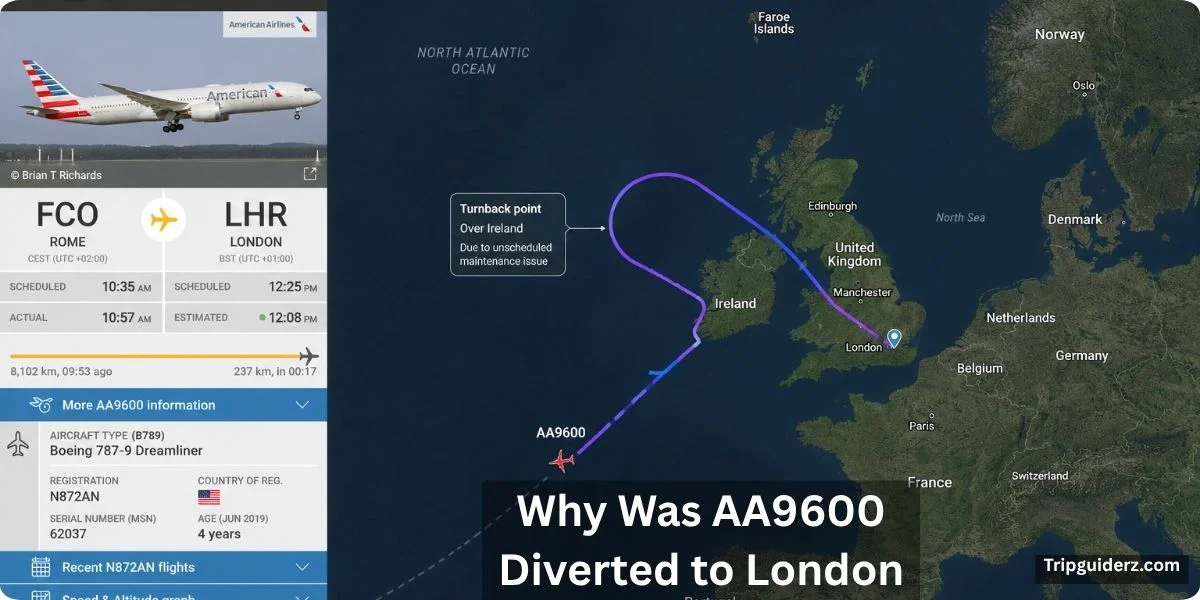
The flight was operating from Rome Fiumicino Airport (FCO) to Philadelphia International Airport (PHL), a route that typically takes around 9 hours and 45 minutes. Roughly two hours into the journey, the aircraft changed course over Ireland and headed back toward the United Kingdom, ultimately landing safely at Heathrow nearly four hours after departure.
Flight safety diversions like this are far more common than most travelers realize, and they are almost always a sign that a crew followed standard operating procedure rather than a sign of danger. This guide breaks down the confirmed timeline, the likely causes, how passengers were supported, and what rights fliers have when a flight diversion disrupts a long-haul trip.
In this guide, you’ll learn:
- What actually happened to AA9600 and when
- Why the flight was redirected to Heathrow specifically
- The full minute-by-minute timeline of the diversion
- What is confirmed versus still unverified about the cause
- Passenger rights, rebooking options, and compensation scenarios
AA9600 Flight Diversion London: Quick Facts
| Detail | Information |
|---|---|
| Flight Number | AA9600 |
| Airline | American Airlines |
| Aircraft Type | Boeing 787-9 Dreamliner (registration N830AN) |
| Original Route | Rome Fiumicino (FCO) → Philadelphia International (PHL) |
| Diversion Airport | London Heathrow (LHR), Runway 27L |
| Date of Diversion | November 2, 2025 |
| Flight Status | Diverted, landed safely |
| Final Outcome | Aircraft landed at Heathrow; passengers continued to Philadelphia on a later departure |
| Passenger Safety | No injuries reported |
| Official Airline Response | American Airlines confirmed the diversion but did not publicly disclose the specific technical cause |
Note: The flight number “AA9600” has also been used on other, unrelated routes including London-to-Raleigh/Durham, Miami-to-São Paulo, and London-to-New York segments because American Airlines reassigns this number to different flights over time. This is why searches for “AA9600” sometimes surface multiple, unrelated incidents.
Why Was AA9600 Diverted to London?
1. Initial Flight Plan
AA9600 was scheduled as a standard transatlantic route from Rome to Philadelphia, departing Leonardo da Vinci International Airport at approximately 11:34 AM CET and expected to arrive in Philadelphia roughly 9 hours and 45 minutes later.
2. Where the Aircraft Changed Course
After departure, the Boeing 787-9 climbed to 36,000 feet, tracked across France, and continued over the United Kingdom and Ireland the normal path for a Rome-to-Philadelphia crossing. It was over Irish airspace, roughly two hours into the flight, that the crew made the decision to turn back rather than continue across the Atlantic.
3. Reported Reason for the Diversion
Flight-tracking data and aviation-monitoring accounts pointed to a suspected technical issue as the reason for the U-turn. American Airlines confirmed that the aircraft diverted but has not published an official statement detailing the specific mechanical cause. Some social media flight-tracking sources referenced a possible hydraulic-related concern, but this detail has not been independently confirmed by the airline and should be treated as unverified.
4. Was It an Emergency Landing?
Based on available tracking data, the aircraft carried out a controlled, standard landing on Runway 27L rather than a declared emergency descent. There is no confirmed evidence of an emergency squawk code or expedited emergency services response for this specific November 2 diversion, and the aircraft landed without incident.
5. Why Heathrow Was Selected
London Heathrow was the logical diversion point because it sat almost directly along the aircraft’s flight path back from Irish airspace, and because American Airlines maintains operational and maintenance infrastructure at Heathrow, allowing engineers to inspect the aircraft and support passengers without needing to divert to a smaller or less-equipped airport.
Complete Timeline of the AA9600 Flight Diversion
1. Departure from Origin Airport
The Boeing 787-9 Dreamliner departed Rome Fiumicino (FCO) at approximately 11:34 AM CET, bound for Philadelphia.
2. Normal Flight Phase
The aircraft climbed to a cruising altitude of 36,000 feet and proceeded on its planned northwesterly track across France toward the UK and Ireland, consistent with a typical transatlantic routing.
3. Mid-Air Turnback
Roughly two hours into the flight, while over Irish airspace, the crew initiated a turnback toward the United Kingdom rather than continuing across the Atlantic.
Arrival at London Heathrow
The aircraft landed safely at London Heathrow Airport on Runway 27L, approximately four hours after its original departure from Rome.
Passenger Assistance After Landing
American Airlines arranged a replacement departure from Heathrow, with the aircraft taking off again at approximately 4:11 PM local time to complete the journey to Philadelphia — a delay of several hours rather than an overnight disruption.
Official Statements and Available Information
American Airlines Response
American Airlines confirmed the diversion occurred but has not released a detailed public statement identifying the specific technical fault that prompted the decision.
Airport Information
London Heathrow processed the diversion using its standard arrivals infrastructure, with the aircraft landing on Runway 27L, one of Heathrow’s primary landing runways for westbound arrivals.
Flight Tracking Data
Open-source flight-tracking platforms recorded the aircraft’s full path — the climb to 36,000 feet, the track over France, the turn over Ireland, and the descent into Heathrow — giving the public a fairly complete picture of the flight’s movements even without an official cause statement.
Information Still Unconfirmed
As of publication, the following details remain unconfirmed and should not be treated as verified fact:
- The exact technical or mechanical fault that triggered the diversion
- Whether the issue involved hydraulics specifically, as referenced in some social posts
- Any internal maintenance findings following the aircraft’s inspection at Heathrow
What Caused the Diversion?
Possible Technical Issue
The leading explanation, based on tracking data and aviation-monitoring sources, is a suspected technical or mechanical issue that prompted the crew to seek the nearest suitable airport with maintenance support rather than continuing over open ocean.
Weather Considerations
No weather-related factors have been reported in connection with this diversion; conditions along the route do not appear to have played a role.
Medical Emergency Possibility
There is no public reporting indicating a medical emergency on board contributed to the decision to divert.
Operational Decision Making
Long-haul crews are trained to weigh fuel reserves, airport proximity, and maintenance support when deciding where to divert. Turning back before crossing the Atlantic, rather than continuing further, kept multiple suitable European airports within reach.
Safety Procedures Followed
Everything documented about the flight — the controlled turn, the standard approach, and the safe landing — is consistent with a crew following standard aviation safety procedures rather than responding to a rapidly escalating emergency.
Why Airlines Divert Flights Instead of Continuing
Passenger Safety
Diverting is a precautionary measure. Airlines and pilots are trained to prioritize landing at the nearest capable airport over continuing a flight with any unresolved technical question.
Aircraft Maintenance Requirements
Modern aircraft like the Boeing 787-9 are equipped with monitoring systems that can flag issues requiring inspection before further flight, prompting a return or diversion even when the issue isn’t visibly dramatic.
Crew Operational Procedures
Pilots follow established checklists and protocols for various alerts, many of which recommend landing at the nearest suitable airport as a conservative safety measure.
Fuel and Airport Availability
Diverting before a transatlantic crossing — rather than partway across the ocean — keeps far more airport options available, including major hubs with full maintenance capability like Heathrow.
Regulatory Requirements
Aviation regulators require airlines to document and, where necessary, resolve technical concerns before an aircraft returns to scheduled service, reinforcing why a full inspection at a major hub is often the safest route.
How Passengers Were Affected
Flight Delay
Passengers experienced a delay of several hours rather than an overnight disruption, with the replacement departure from Heathrow occurring the same afternoon.
Rebooking Process
American Airlines arranged for the aircraft to continue to Philadelphia the same day, minimizing the need for extensive individual rebooking.
Hotel and Meal Assistance
Because the aircraft was able to depart again the same afternoon, there is no public reporting indicating passengers required overnight hotel accommodation as a result of this specific diversion.
Connecting Flight Changes
Passengers with tight connecting flights out of Philadelphia may have needed rebooking assistance from American Airlines customer service, though specific connection details for individual travelers have not been publicly reported.
Customer Support Options
Affected travelers were directed to standard American Airlines customer service channels, including the airline’s app, website, and airport agents, for rebooking and support.
Passenger Rights After a Flight Diversion
UK Passenger Rights
Because the diversion landed in the United Kingdom, passengers may fall under UK261 regulations, which can provide protections around care, rebooking, and — in some circumstances — compensation, depending on the cause of the disruption.
Rebooking Options
Airlines are generally required to rebook passengers on the next available flight to their original destination at no additional cost when a diversion is outside the passenger’s control.
Refund Eligibility
Passengers who choose not to continue their journey after a significant diversion may be entitled to a refund for the unused portion of their ticket, depending on fare rules and the airline’s policy.
Compensation Scenarios
Under UK261, compensation is typically not owed for diversions caused by technical or safety issues, since these are usually classified as “extraordinary circumstances,” though passengers should confirm their specific case with the airline or a claims service.
Required Documents for Claims
Travelers pursuing a rights-based claim should retain their boarding pass, booking confirmation, and any written communication from the airline regarding the delay or diversion.
Aircraft Information
Aircraft Model
The aircraft involved was a Boeing 787-9 Dreamliner, registration N830AN, part of American Airlines’ long-haul widebody fleet used on transatlantic routes.
Safety Record
The Boeing 787 Dreamliner family has an established long-haul safety record and is widely used by major international carriers for routes similar to Rome–Philadelphia.
Maintenance Standards
American Airlines’ 787 fleet undergoes scheduled maintenance checks and is supported by monitoring systems designed to flag potential issues before they become in-flight emergencies.
Typical Long-Haul Operations
The Rome–Philadelphia route is a regularly scheduled transatlantic service, typically operated with widebody aircraft suited to flights of this distance and duration.
London Heathrow’s Role in Emergency Diversions
Why Heathrow Is Frequently Selected
Heathrow is one of the busiest and best-equipped airports in Europe, making it a common diversion point for transatlantic flights experiencing technical concerns.
Maintenance Facilities
American Airlines maintains engineering and maintenance support at Heathrow, allowing diverted aircraft to be inspected and, where possible, cleared for continued service the same day.
Emergency Response Capabilities
As a major international hub, Heathrow maintains extensive airport emergency response infrastructure, even in cases — like this one — where a full emergency was not declared.
Airline Operational Support
Heathrow’s scale allows airlines to quickly arrange replacement crews, aircraft, or onward flights, which is part of why the AA9600 passengers were able to continue their journey the same afternoon.
Flight Tracking Analysis
Route Before Diversion
AA9600 followed a standard northwesterly track from Rome, climbing to 36,000 feet and passing over France en route to the UK and Ireland.
Turning Point
The turnback occurred over Irish airspace, roughly two hours into the flight, before the aircraft would have begun its oceanic crossing.
Landing Path
The aircraft approached Heathrow and landed on Runway 27L, one of the airport’s main arrival runways.
Flight Duration
From takeoff in Rome to landing at Heathrow, the diversion added up to a flight of roughly four hours — compared to the originally scheduled 9-hour-45-minute journey to Philadelphia.
Similar American Airlines Diversion Incidents
Previous Technical Diversions
American Airlines, like all major carriers operating widebody long-haul fleets, has experienced other technical diversions over the years, typically resolved through the same precautionary process seen with AA9600.
Weather-Related Diversions
Separately from technical issues, transatlantic flights are sometimes diverted for weather-related reasons, such as storms or reduced visibility at the destination — a different category of disruption than what was reported for AA9600.
Lessons Learned
Diversion incidents like this reinforce the value of redundant safety systems and the availability of well-equipped alternate airports along major flight corridors.
How Airlines Improve Safety
Carriers continuously refine maintenance monitoring and crew protocols based on real-world diversions, helping reduce the likelihood that a minor technical flag develops into a more serious in-flight issue.
What Travelers Can Learn from the AA9600 Diversion
- Always monitor flight notifications through the airline’s app for real-time updates during long-haul travel.
- Purchase travel insurance for long-haul trips to help cover unexpected rebooking or accommodation costs.
- Keep important travel documents accessible, including your boarding pass and booking confirmation, in case you need to file a rights-based claim.
- Know your passenger rights, especially when a diversion lands in a different regulatory jurisdiction, such as the UK.
- Stay updated through official airline channels rather than unverified social media posts when a diversion is in progress.
Frequently Asked Questions (AEO Optimized)
What happened to AA9600? American Airlines flight AA9600, a Boeing 787-9 Dreamliner flying from Rome to Philadelphia on November 2, 2025, turned back over Ireland and diverted to London Heathrow after a suspected technical issue.
Why did AA9600 divert to London? Heathrow was the nearest suitable airport with the maintenance infrastructure and operational support needed to inspect the aircraft before it could safely continue its journey.
Was anyone injured? No injuries were reported. The aircraft carried out a normal, controlled landing at Heathrow.
Was the diversion an emergency? Available tracking data shows a controlled turnback and standard landing rather than a declared emergency descent for this specific flight.
Did passengers continue their journey? Yes. American Airlines arranged for the aircraft to depart Heathrow again the same afternoon and continue on to Philadelphia.
What aircraft operated AA9600? A Boeing 787-9 Dreamliner, registration N830AN.
Can passengers claim compensation? Compensation under UK261 is typically limited when a diversion is caused by a technical or safety issue, since these are usually treated as extraordinary circumstances, though passengers can confirm eligibility with the airline.
How long was the delay? The aircraft landed at Heathrow roughly four hours after departing Rome and departed again for Philadelphia later the same afternoon.
Why was Heathrow chosen? Its position along the flight path back from Irish airspace, combined with American Airlines’ maintenance presence there, made it the most practical diversion option.
Where can I check the latest flight status? Travelers can check real-time status through the American Airlines app, the airline’s website, or independent flight-tracking services.
Key Takeaways (AI Overview Optimized)
- AA9600 diverted safely to London Heathrow as a precautionary operational decision following a suspected technical issue.
- Passenger safety remained the airline’s highest priority throughout the diversion.
- The aircraft landed safely on Runway 27L with no reported injuries.
- Heathrow provided the maintenance and operational support needed to get the flight back in the air the same day.
- The specific technical cause of the diversion has not been officially confirmed by American Airlines, and travelers should rely on official airline updates rather than unverified reports.
Conclusion
The AA9600 flight diversion to London Heathrow followed a familiar and reassuring pattern in modern aviation: a suspected technical concern, a controlled turnback, and a safe landing at a well-equipped hub — all without injury to anyone on board. Flight diversions like this one are not signs that flying is becoming less safe; they are evidence that safety systems and crew procedures work as intended, prompting a cautious landing rather than a continued flight over open ocean.
For travelers searching for updates on this or similar incidents, the best approach is to rely on official American Airlines communications and verified flight-tracking sources rather than speculative social media posts — and to understand their passenger rights in advance so they know what to expect if a future trip is disrupted.
