
Germany has become one of Europe’s most sought-after study destinations, and the numbers back it up the country now hosts over 400,000 international students, drawn by tuition-free public universities, globally recognized degrees, and a fast-growing catalog of English-taught programs. But before you can start classes, you’ll need to clear one major hurdle: the Germany student visa (Visum zu Studienzwecken).
This guide walks you through everything you need to know, starting with who actually needs a visa (it depends on your nationality and program length), how the German Federal Foreign Office determines your required proof of funds, and how the blocked account, or Sperrkonto, works in practice. As of 2026, applicants must deposit €11,904 into a blocked account to cover one year of living costs, released in monthly installments of €992 under rates set by the Federal Training Assistance Act (BAföG).
Beyond the financial requirement, we cover the full application timeline, from booking your embassy appointment to picking up your visa, along with what to expect after you land, registering your address, activating your blocked account, and enrolling in mandatory health insurance.
Whether you’re heading to Berlin for a master’s degree or Heidelberg for a language course, this roadmap draws on current embassy guidelines and official visa requirements to help you avoid the delays and rejections that trip up thousands of applicants each year.
What Is a Germany Student Visa?
1. Definition
A Germany student visa is a national long-stay visa (Visum zu Studienzwecken), officially known as a “Type D” visa, that allows non-EU/EEA citizens to enter Germany for full-time study at a recognized university, Studienkolleg, or accredited academic program. It’s issued by German embassies and consulates abroad and is the entry point into Germany’s longer residence permit system.
2. Who Needs It?
Citizens of countries outside the EU, EEA, and a short list of visa-exempt nations (including the US, Canada, Australia, Japan, South Korea, Israel, and New Zealand) generally need a student visa before traveling to Germany for studies lasting longer than 90 days.
3. Who Doesn’t Need a Visa?
- Citizens of EU/EEA member states and Switzerland
- Citizens of visa-exempt countries planning stays under 90 days who intend to apply for a residence permit for study purposes after arrival (this route is limited to a specific list of nationalities)
- Holders of certain existing German or Schengen residence titles
4. Student Visa vs Residence Permit
The student visa is your entry ticket it’s valid for up to 90 or 180 days, depending on the consulate. Once you arrive in Germany, register your address, and enroll at your institution, you must convert it into a residence permit for study purposes at the local Foreigners’ Authority (Ausländerbehörde). The residence permit is what actually authorizes your continued stay and is typically issued for one to two years at a time, renewable until you graduate.
Types of Germany Student Visas
1. Student Visa (Visum zu Studienzwecken)
This is the primary visa category for applicants who already hold an unconditional or conditional admission letter from a German university and are ready to enroll in a full degree program. It’s issued as a national (Type D) visa and, once in Germany, is converted into a residence permit at the local Ausländerbehörde. Applicants need to show all core eligibility documents at the upfront admission letter, blocked account or equivalent proof of funds, and health insurance since this visa is intended for students who are essentially ready to start their studies with minimal additional steps.
2. Student Applicant Visa
Designed for applicants who haven’t secured admission yet, this visa allows travel to Germany to apply to universities in person, sit entrance exams, attend interviews, or complete other admission requirements that can’t be handled remotely. It’s shorter in duration than a full student visa typically valid for a few months and must be converted into a full student visa at the local immigration office once an admission offer is confirmed. This route is common for programs with competitive entrance exams or interview-based selection processes, such as art, music, or medical programs.
3. Language Course Visa
This visa is intended for students enrolling in an intensive German language course, typically required as a prerequisite before starting a degree program that demands B2 or C1 proficiency. It’s especially relevant for applicants whose German isn’t yet strong enough to meet a university’s language requirement but who plan to study a German-taught program. Depending on the course length and the applicant’s ultimate study plans, this visa may also need to be extended or converted once language proficiency requirements are met and university enrollment begins.
4. Research Visa
Aimed at doctoral candidates, postdocs, and visiting researchers joining a German university or research institution, this visa is issued under a hosting agreement between the researcher and the host institution. Because the hosting agreement already establishes the purpose and legitimacy of the stay, this visa is often processed faster than standard student visas, and in many cases doesn’t require the same blocked account proof of funds, since funding is typically already confirmed through a research contract, scholarship, or institutional stipend.
5. Vocational Training Visa
This visa is for applicants pursuing recognized vocational training (Ausbildung) programs rather than academic degrees a distinctly German education pathway that combines practical, paid on-the-job training with classroom instruction. It’s common in fields facing labor shortages, including healthcare (such as nursing), engineering, IT, and skilled trades like electrical work or mechatronics. Because Ausbildung programs typically include a training salary, applicants may be able to rely on this income rather than a blocked account to prove financial support, depending on the specific program and employer.
| Visa Type | Purpose | Typical Duration | Can Convert? |
|---|---|---|---|
| Student Visa | Confirmed university admission | 90–180 days, then residence permit | Converts to Residence Permit for Study Purposes |
| Student Applicant Visa | Applying for admission in person | Up to 90 days | Converts to full Student Visa once admitted |
| Language Course Visa | Intensive German language study | Length of course | Can convert to Student Visa on admission |
| Research Visa | PhD/postdoc/research stays | Length of research agreement | Converts to Residence Permit for Research |
| Vocational Training Visa | Recognized Ausbildung programs | Length of training contract | Converts to Residence Permit for Training |
Germany Student Visa Requirements (2026)
- Valid passport: Must be valid for the entire intended stay, with at least two blank pages.
- University admission letter: An unconditional or conditional Zulassungsbescheid from a recognized German institution.
- Proof of financial resources: Most commonly a blocked account, though scholarships, formal sponsorship declarations (Verpflichtungserklärung), or parental income proof can also qualify depending on the embassy.
- Health insurance: Either provisional travel insurance for the visa application, followed by full German student health insurance after arrival, or full coverage from day one.
- Academic documents: Transcripts, degree certificates, and any required Academic Evaluation Centre (APS/uni-assist) certification.
- Visa application form: Completed and signed, usually via the embassy’s online portal.
- Passport photos: Biometric, per German visa photo specifications.
- Visa fee: Currently €75 for adults and €37.50 for minors.
- Statement of purpose: A short letter of motivation explaining your study plans and career goals.
- Language proficiency: Proof of German (usually B1/B2) or English proficiency (IELTS/TOEFL), depending on your program’s teaching language.
- Accommodation proof: A rental contract, dormitory confirmation, or formal invitation letter for your first weeks in Germany.
Germany Blocked Account Explained
1. What Is a Blocked Account?
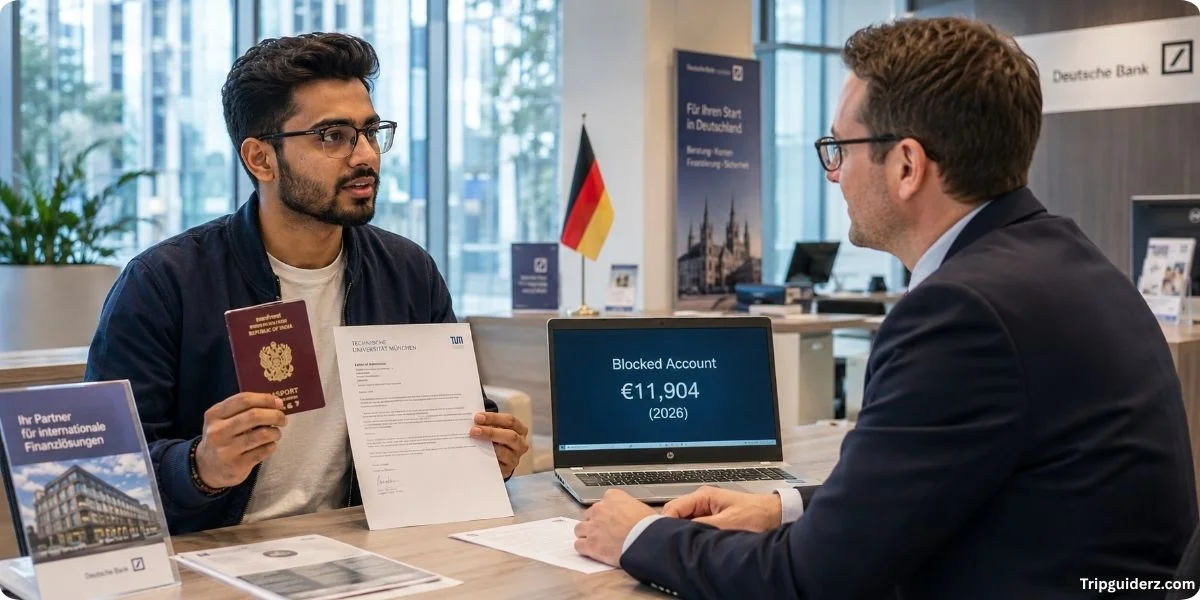
A blocked account (Sperrkonto) is a special German bank account that holds a set amount of money as proof you can support yourself financially during your studies. Funds are released to you in fixed monthly installments rather than all at once, so the embassy can be confident you won’t run out of money mid-year.
2. Minimum Amount Required (2026)
The blocked account requirement for 2026 remains €11,904 per year, or €992 per month, unchanged from 2025. This figure is set annually by the German Federal Foreign Office based on the BAföG student living-allowance rate. Applicants for the Job Seeker visa or Opportunity Card typically need a higher amount, around €13,092 per year (€1,091 per month) in 2026.
Flag for review: A couple of sources reference a lower figure (~€11,208) for 2026 this appears to be an outdated or unofficial number. The €11,904/€992 figure is the one confirmed by the largest number of current, BAföG-linked sources and should be verified against the applicant’s specific embassy before publishing final figures, since requirements can vary slightly by consulate and are reviewed periodically.
3. Approved Providers
Common recognized blocked account providers include Expatrio, Fintiba, and Studely. Most major German retail banks don’t offer standalone blocked accounts for applicants still living abroad, so specialized digital providers are the standard route.
4. Monthly Withdrawal Limit
Once activated in Germany, account holders can withdraw up to €992 per month from the blocked account into their regular checking account.
5. Alternatives to a Blocked Account
- A formal declaration of commitment (Verpflichtungserklärung) from a German resident sponsor
- A recognized scholarship covering living costs (DAAD, Erasmus+, etc.)
- Proof of parental income/bank statements, accepted by some but not all consulates
Germany Student Visa Eligibility
1. Working Hour Limits
As of 2026, international students on a non-EU student residence permit can work up to 140 full days or 280 half days per year without needing separate approval from the Federal Employment Agency. A working day of up to four hours counts as half a working day, so a full day is any shift longer than four hours. Students can mix and match for example, working full days during semester breaks and half days during term as long as the combined total stays within the annual allowance, which resets each calendar year. Alternatively, students may choose to work up to 20 hours per week during the lecture period instead, and can work without restriction during semester breaks.
2. Part-Time Jobs
Common student jobs in Germany span campus assistant roles (HiWi positions), retail, hospitality, tutoring, and administrative “mini-jobs,” all widely available in every university city. HiWi jobs working as a research or teaching assistant for a professor are especially popular since they build academic experience directly relevant to a student’s field. On-campus jobs like HiWi positions are exempt from the 140-day limit and do not count toward the annual allowance, making them one of the more flexible options for students who want to work more without eating into their day count.
3. Student Internships
Mandatory curricular internships tied to a degree program generally don’t count against a student’s working-day allowance, since they’re treated as an academic requirement rather than standard employment. Voluntary internships, taken by personal choice rather than degree requirement, do count toward the annual limit. Because rules can vary by case, it’s always worth confirming directly with the local Foreigners’ Authority (Ausländerbehörde) before starting any internship to avoid accidentally exceeding the allowance.
4. Taxes
Students earning above the annual tax-free allowance may owe income tax, though most part-time student earnings fall below the threshold or qualify for simplified “mini-job” tax treatment. Minijobs pay up to about €603 per month gross in 2026 under simplified tax rules, making them a low-hassle option for students who want to earn without dealing with income tax filing. Students earning more, such as through a Werkstudent role, may need to file an annual tax return, though much of what’s withheld is often refundable depending on total yearly income.
5. Salary Expectations
Typical student jobs pay close to Germany’s minimum wage, which stands at €13.90 per hour as of 2026. Higher rates are common for skilled roles like tutoring, IT support, or Werkstudent (working student) positions tied to a student’s field of study. Werkstudent roles typically pay in the range of €14–€20 per hour or more, reflecting the more specialized nature of the work compared to general part-time jobs.
Documents Checklist
| Document | Mandatory | Notes |
|---|---|---|
| Valid passport | Yes | Must cover entire stay |
| University admission letter | Yes | Conditional accepted for some visa types |
| Blocked account confirmation | Yes (or equivalent) | €11,904 minimum for 2026 |
| Health insurance proof | Yes | Travel insurance accepted initially |
| Academic transcripts/certificates | Yes | APS/uni-assist certification if applicable |
| Passport photos | Yes | Biometric standard |
| Visa application form | Yes | Completed via embassy portal |
| Statement of purpose | Yes | Program-specific motivation letter |
| Language proficiency certificate | Yes | IELTS/TOEFL or German level certificate |
| Accommodation proof | Recommended | Not always mandatory at visa stage |
| CV/resume | Recommended | Some embassies request it |
| Visa fee payment receipt | Yes | €75 for adults |
Germany Student Visa Application Process
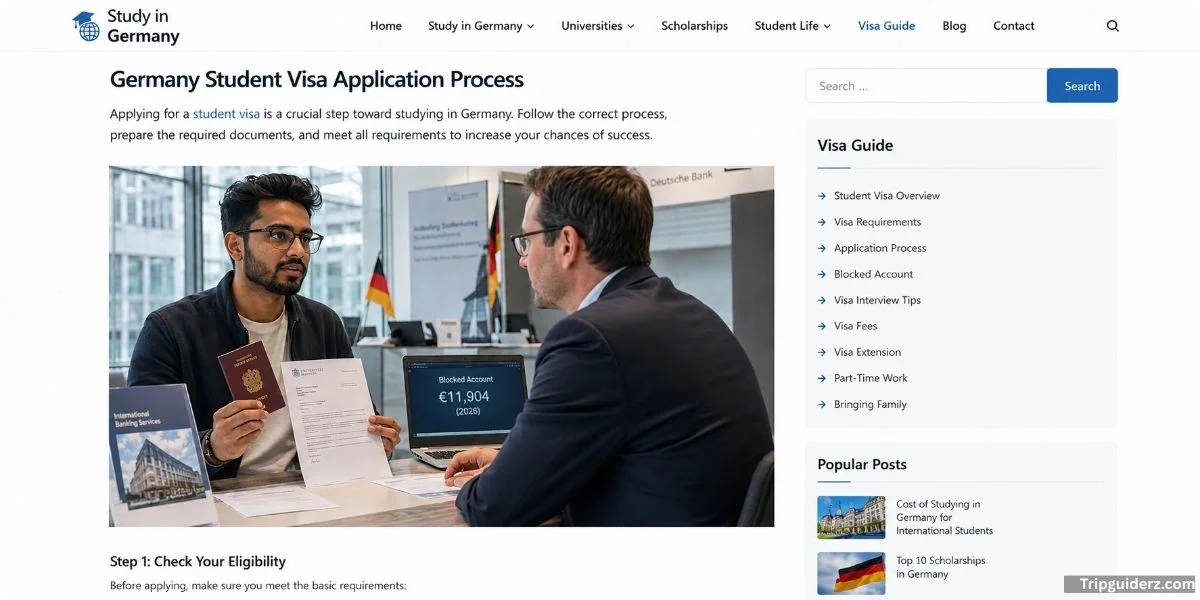
Step 1 — Get Admission: Secure a conditional or unconditional admission letter from a recognized German university.
Step 2 — Open a Blocked Account: Set up your Sperrkonto with an approved provider and deposit the required minimum.
Step 3 — Purchase Health Insurance: Arrange provisional or full student health insurance valid from your intended travel date.
Step 4 — Book Embassy Appointment: Schedule your visa appointment as early as possible slots fill up fast during peak intake months.
Step 5 — Prepare Documents: Compile the full checklist above, translated and certified where required.
Step 6 — Attend Interview: Attend your in-person appointment, submit biometrics, and answer questions about your study plans.
Step 7 — Wait for Decision: Processing typically runs several weeks, depending on your consulate.
Step 8 — Travel to Germany: Enter Germany within the visa’s validity window.
Step 9 — Register Address: Complete your Anmeldung (address registration) at the local citizens’ office within two weeks of moving in.
Step 10 — Apply for Residence Permit: Convert your visa into a residence permit for study purposes at the Foreigners’ Authority before your visa expires.
Germany Student Visa Processing Time
Standard processing for student visa applications generally runs 4–8 weeks, depending on the educational institution’s documentation and the applicant’s academic background. That said, actual timelines vary significantly by country for example, roughly 12 weeks in India versus around 6 weeks in Iran.
- Peak season delays: Applications submitted between June and September typically take 15–25% longer due to the summer intake rush, and December applications can also slow down around holiday closures.
- Fastest processing countries: Consulates with lower application volumes and streamlined digital portals tend to process faster; smaller consulates can sometimes turn around applications quicker than high-demand hubs.
Tips to avoid delays:
- Apply at least 3 months before your intended start date
- Book your appointment the moment your admission letter arrives
- Submit a complete document set the first time missing paperwork is the top cause of resubmission delays
- Avoid peak intake windows where possible
Germany Student Visa Fees
| Fee | Amount |
|---|---|
| National (D) visa fee — adults | €75 |
| National (D) visa fee — minors | €37.50 |
| Blocked account setup (varies by provider) | ~€30–€60 |
| Blocked account monthly fee | ~€3–€10 |
| Health insurance (public, monthly) | ~€120–€135 |
| APS/uni-assist certification (where required) | Varies by country |
| Residence permit fee (after arrival) | ~€100 (first issuance) |
Germany Student Visa Interview Questions
Expect a short, conversational interview focused on the genuineness of intent. Common questions include:
- Why Germany? Be specific about the country’s academic reputation, low or no tuition fees, and career opportunities in your field.
- Why this university? Reference specific faculty, research strengths, or program structure.
- Future plans? Outline how the degree connects to your career goals, whether in Germany or your home country.
- Funding source? Be ready to explain your blocked account, scholarship, or sponsor in plain terms.
- Accommodation? Mention any dormitory application, WG search, or temporary housing plan.
- Course details? Know your program length, credit structure, and core modules.
How to Increase Germany Student Visa Approval Chances
- Complete documentation: submit every required document in the correct format the first time
- Genuine financial proof: make sure your blocked account or sponsor documentation matches the current minimum exactly
- Strong SOP: a specific, well-structured statement of purpose outperforms generic templates
- Interview preparation: rehearse clear, honest answers about your study and career plans
- Honest answers: inconsistencies between your documents and interview answers are a leading rejection trigger
- Proper travel plans: have a realistic itinerary and accommodation plan ready to reference
Can You Work on a Germany Student Visa?

1. Working Hour Limits
As of 2026, international students on a non-EU student residence permit can work up to 140 full days or 280 half days per year without needing separate approval from the Federal Employment Agency. A working day of up to four hours counts as half a working day, so a full day is any shift longer than four hours. Students can mix and match for example, working full days during semester breaks and half days during term as long as the combined total stays within the annual allowance, which resets each calendar year. Alternatively, students may choose to work up to 20 hours per week during the lecture period instead, and can work without restriction during semester breaks.
2. Part-Time Jobs
Common student jobs in Germany span campus assistant roles (HiWi positions), retail, hospitality, tutoring, and administrative “mini-jobs,” all widely available in every university city. HiWi jobs working as a research or teaching assistant for a professor are especially popular since they build academic experience directly relevant to a student’s field. On-campus jobs like HiWi positions are exempt from the 140-day limit and do not count toward the annual allowance, making them one of the more flexible options for students who want to work more without eating into their day count.
3. Student Internships
Mandatory curricular internships tied to a degree program generally don’t count against a student’s working-day allowance, since they’re treated as an academic requirement rather than standard employment. Voluntary internships, taken by personal choice rather than degree requirement, do count toward the annual limit. Because rules can vary by case, it’s always worth confirming directly with the local Foreigners’ Authority (Ausländerbehörde) before starting any internship to avoid accidentally exceeding the allowance.
4. Taxes
Students earning above the annual tax-free allowance may owe income tax, though most part-time student earnings fall below the threshold or qualify for simplified “mini-job” tax treatment. Minijobs pay up to about €603 per month gross in 2026 under simplified tax rules, making them a low-hassle option for students who want to earn without dealing with income tax filing. Students earning more, such as through a Werkstudent role, may need to file an annual tax return, though much of what’s withheld is often refundable depending on total yearly income.
5. Salary Expectations
Typical student jobs pay close to Germany’s minimum wage, which stands at €13.90 per hour as of 2026. Higher rates are common for skilled roles like tutoring, IT support, or Werkstudent (working student) positions tied to a student’s field of study. Werkstudent roles typically pay in the range of €14–€20 per hour or more, reflecting the more specialized nature of the work compared to general part-time jobs.
Cost of Living in Germany for Students
| Expense | Monthly Cost (approx.) |
|---|---|
| Rent (shared/dorm) | €400–€700 |
| Food | €200–€250 |
| Transportation | €30–€60 (many cities offer discounted semester tickets) |
| Health insurance | €120–€135 |
| Internet | €20–€30 |
| Utilities | €40–€60 |
| Entertainment | €50–€80 |
Best Student Cities in Germany
1. Berlin
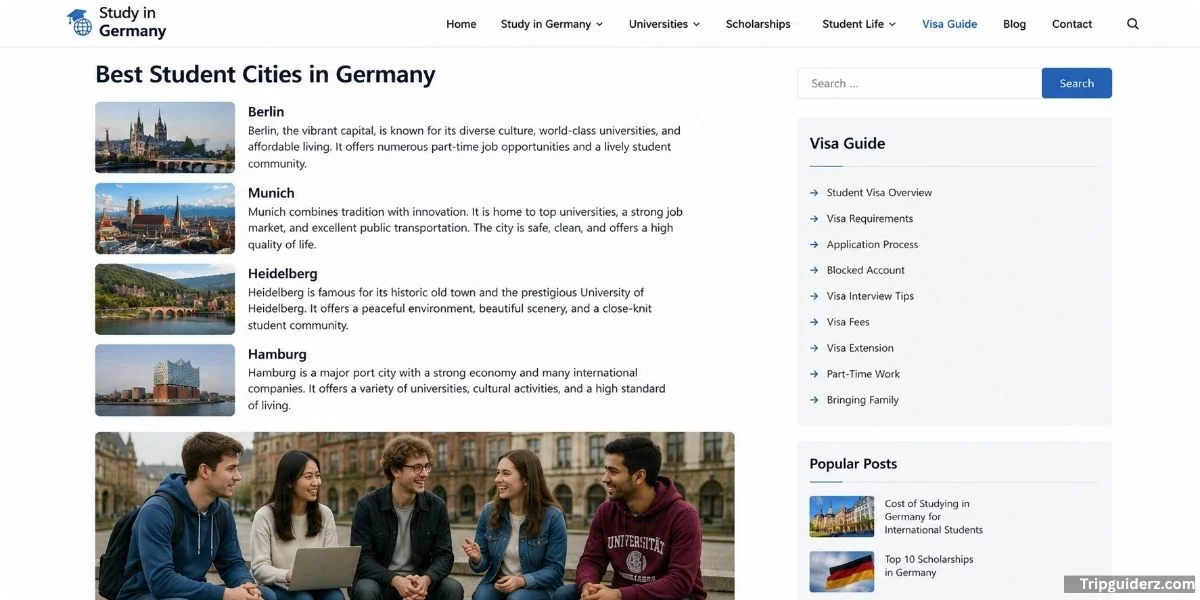
Germany’s capital and largest student hub, Berlin pairs a world-class arts and nightlife scene with one of the country’s densest university networks, including Humboldt University and Freie Universität Berlin. Its thriving startup ecosystem draws students in tech, design, and entrepreneurship, while the city’s history and multicultural neighborhoods make it a magnet for international students. The trade-off: rents have climbed steadily in recent years, and Berlin now ranks among the pricier German cities to live in, even if it’s still more affordable than many other European capitals.
2. Munich
Munich is home to two of Germany’s top-ranked universities, Ludwig Maximilian University (LMU) and the Technical University of Munich (TUM), both especially strong in engineering, business, and the natural sciences. The city’s proximity to major employers like BMW, Siemens, and Allianz makes it a launchpad for internships and post-graduation careers. Munich’s polished infrastructure, safety, and quality of life come at a cost, though it’s consistently one of Germany’s most expensive cities for rent and daily expenses.
3. Hamburg
As one of Europe’s largest port cities, Hamburg offers strong programs in media, logistics, shipping, and business, backed by its status as a major commercial hub. Universities like Universität Hamburg and HafenCity University give students access to a dynamic mix of academic and industry connections. Compared to Munich, Hamburg offers a more moderate cost of living, while still delivering a big-city experience with a strong job market.
4. Frankfurt
Frankfurt is Germany’s undisputed financial capital, hosting the European Central Bank and a dense cluster of international banks making it a natural fit for students pursuing finance, economics, and business degrees. Goethe University Frankfurt has built a strong reputation in these fields. The city’s international airport and central location give it excellent connectivity across Europe, appealing to students who want easy access to travel and global business networks.
5. Leipzig
Leipzig has emerged as one of eastern Germany’s most attractive student cities, combining affordability with a fast-growing creative and tech scene. Once known primarily for its musical heritage (Bach and Mendelssohn both worked here), the city has reinvented itself with a thriving arts community, indie culture, and expanding startup activity. For students watching their budget without wanting to sacrifice city life, Leipzig is often cited as one of the best value options in the country.
6. Dresden
Dresden pairs a reputation for engineering and technology anchored by the Technische Universität Dresden with a noticeably lower cost of living than cities in western Germany. Rebuilt after WWII with a stunning baroque old town, Dresden offers students a blend of historic charm and modern research infrastructure, particularly in microelectronics and materials science, without the price tag of cities like Munich or Frankfurt.
7. Aachen
Aachen is defined by RWTH Aachen University, one of Europe’s leading technical universities and a top choice for engineering students in fields like mechanical engineering, computer science, and electrical engineering. Sitting at the crossroads of Germany, Belgium, and the Netherlands, the city has a distinctly international, cross-border feel. Its relatively small size makes it a walkable, close-knit student town compared to Germany’s larger metros.
8. Heidelberg
Heidelberg is home to Ruprecht-Karls-Universität Heidelberg, founded in 1386 and the oldest university in Germany. The city offers a classic, storybook college-town atmosphere, with a hilltop castle, cobblestone streets, and the Neckar River running through it. Heidelberg is especially strong in medicine, law, and the humanities, and its compact size and historic charm make it one of the most picturesque places to study in the country.
| City | Living Cost | Known For | Part-Time Jobs |
|---|---|---|---|
| Berlin | High | Arts, startups, tech | Plentiful, competitive |
| Munich | Highest | Engineering, business | Strong but pricier city |
| Hamburg | Moderate–High | Media, logistics, business | Good port-city economy |
| Frankfurt | High | Finance, economics | Strong finance-sector jobs |
| Leipzig | Low | Creative industries, tech | Growing job market |
| Dresden | Low–Moderate | Engineering, technology | Steady demand |
| Aachen | Moderate | Technical/engineering studies | Campus-driven jobs |
| Heidelberg | Moderate | Research, humanities | Limited but stable |
Scholarships for International Students
- DAAD: Germany’s national academic exchange service, offering scholarships across nearly every field and degree level
- Erasmus+: EU-funded mobility and exchange grants, including for non-EU partner countries
- Deutschlandstipendium: a merit-based national scholarship co-funded by private sponsors
- University scholarships: many institutions offer their own need- or merit-based funding
- Private foundations: political, religious, and industry-affiliated foundations offering additional funding routes
Health Insurance for Students
1. Public Insurance
Public health insurance (gesetzliche Krankenversicherung) is mandatory for most students under 30 who are enrolled in a German university as full-time degree candidates. Premiums are income-independent, meaning every student pays roughly the same rate regardless of financial background, and coverage is comprehensive including doctor visits, hospital stays, prescriptions, and basic dental care. Popular providers among international students include TK (Techniker Krankenkasse), AOK, and Barmer, all of which offer English-language support and are well-versed in processing enrollment for foreign students.
2. Private Insurance
Private insurance (private Krankenversicherung) becomes an option or in some cases a requirement for students over 30, doctoral candidates, and those enrolled in preparatory or language programs who aren’t yet officially matriculated in a degree course. Private plans are often cheaper upfront, particularly for younger applicants, but premiums are typically based on age and health status rather than being fixed, and switching back to public insurance later can be difficult once a student has opted out. Private plans also tend to offer fewer long-term protections, such as guaranteed premium caps or coverage continuity if health conditions change.
3. Which One Should You Choose?
For the majority of degree-seeking students under 30, public insurance is the default choice thanks to its simplicity, predictable cost, and broad coverage that satisfies university enrollment requirements without extra paperwork. Private insurance tends to suit a narrower group: students over 30 who fall outside public insurance eligibility, doctoral candidates on research contracts, or applicants who need short-term interim coverage while finalizing their visa or enrollment status. Because switching from private back to public insurance later can be complicated, it’s worth thinking through long-term plans not just upfront cost, before choosing.
4. Average Cost
Public student health insurance typically runs around €120–€135 per month, covering students up to age 30 (or slightly older in some cases, such as extended studies). Private insurance premiums vary more widely depending on age, health, and the specific plan, and can sometimes start lower but rise over time. Students should also budget for the mandatory semester contribution some universities collect separately, which can include additional health-related fees.
Accommodation Options
1. Student Dormitories
Dormitories (Studentenwohnheime) run by regional Studentenwerk organizations are the most affordable housing option available to students in Germany, with rents often significantly below market rate for private housing. Rooms typically range from simple single rooms to shared flats within the dorm complex, and many include utilities in the monthly rate. The catch is that demand far outstrips supply in major university cities like Munich, Berlin, and Heidelberg, so it’s essential to apply as early as possible ideally as soon as you have your university admission confirmation, since waitlists can stretch for months.
2. Shared Apartments (WG)
A Wohngemeinschaft, or WG, is one of the most popular housing choices among students, offering a private room within a shared flat while splitting common spaces like the kitchen and living room with flatmates. Platforms like WG-Gesucht are the go-to resource for finding listings, and WGs tend to offer more flexibility than dorms shorter notice periods, more control over who you live with, and often a more social living environment. They’re especially popular with international students who want to build a local network quickly.
3. Private Apartments
Renting a private apartment (Wohnung) offers the most independence but comes at a higher cost and with more hurdles to clear. Landlords typically require a Schufa credit report, which tracks financial reliability in Germany a significant obstacle for newly arrived international students who haven’t yet built a German credit or rental history. Additional requirements often include proof of income or a guarantor, a deposit of up to three months’ rent, and sometimes German language proficiency for lease negotiations, making this route more common among students further along in their studies or postgraduate programs.
4. Temporary Accommodation
For the first few weeks after arrival, many students rely on temporary housing such as guesthouses, hostels, or serviced apartments while they search for something permanent. This bridge period can take longer than expected in competitive housing markets, so budgeting for several weeks of short-term stays is wise. Some universities and Studentenwerk organizations also offer limited short-term “welcome” housing specifically for incoming international students during their first semester.
Residence Permit After Arrival
- Required documents: passport, biometric photo, proof of enrollment, blocked account confirmation, health insurance, and proof of address registration.
- Registration process: register your address (Anmeldung) at the local citizens’ office within two weeks of arrival, then book an appointment at the Foreigners’ Authority for your residence permit.
- Timeline: appointments can take several weeks to secure in high-demand cities, so book as early as your enrollment allows.
- Renewal process: residence permits for study purposes are typically renewed annually until you complete your degree, requiring updated enrollment and financial proof each time.
Can You Bring Family?
1. Spouse
Spouses of international students can apply for a dependent residence permit (Aufenthaltserlaubnis zum Ehegattennachzug) to join them in Germany. This generally requires proof of a legally registered relationship, along with evidence that the couple can financially support themselves without relying on public assistance. Processing times and specific document requirements can vary by German consulate or local Ausländerbehörde (immigration office), so it’s worth applying with plenty of lead time before the planned move.
2. Children
Minor children can typically join a parent studying in Germany under a family reunification permit, applied for alongside or shortly after the parent’s student visa. Once in Germany, children of school age are generally required to enroll in the local public school system, and some cities offer preparatory classes to help non-German-speaking children integrate into the curriculum.
3. Requirements
Core documentation for family reunification includes a registered marriage or partnership certificate, valid passports for every family member, and proof of health insurance coverage for each person joining the student. Some Ausländerbehörden may also request additional documents such as birth certificates for children or proof of adequate housing space for the whole family, so requirements can vary somewhat by region.
4. Financial Proof
Because a student visa already requires proof of funds to cover one person’s living expenses, bringing family members means demonstrating additional financial resources on top of that baseline enough to show the whole family can support itself without needing public benefits. This is often shown through a blocked account, proof of a scholarship covering dependents, or evidence of the spouse’s own income if they plan to work in Germany.
Can You Stay in Germany After Graduation?
1. Job Seeker Residence Permit
After graduating from a German university, international students can apply for an 18-month job seeker residence permit, which allows them to stay in Germany specifically to search for employment matching their qualifications. During this period, holders are permitted to take on jobs to support themselves while searching, but the work must generally be related to or building toward their qualifying field once a permanent position is secured. This permit doesn’t require a job offer to obtain — it’s designed to give graduates runway to find one.
2. EU Blue Card
Once a graduate secures a qualifying job offer above the required salary threshold, they can transition from the job seeker permit to an EU Blue Card, Germany’s fast-track residence status for highly qualified non-EU professionals. The 2026 salary thresholds are €50,700 gross per year for standard occupations and €45,934.20 for shortage occupations, recent graduates within three years of graduation, and qualifying IT specialists. Beyond the salary requirement, applicants generally need a recognized university degree and a binding employment contract. The Blue Card is attractive not just for the residency benefits but because it offers immediate work rights for a spouse and no German language requirement at the point of application.
3. Permanent Residence Pathway
Graduates working in Germany under an EU Blue Card benefit from one of the fastest routes to permanent residence available. Blue Card holders can reach permanent residence in as little as 21 months with B1-level German proficiency, or 27 months without it notably shorter than the standard permanent residence timeline required under other visa categories, which typically takes several years. This accelerated path is one of the key incentives Germany offers to retain international graduates in its skilled workforce.
Common Germany Student Visa Rejection Reasons
- Insufficient or improperly documented funds
- A weak or generic statement of purpose
- Incomplete document sets
- Fake or inconsistent documents
- A poor or inconsistent interview performance
- Unclear or unconvincing study plans
How to Appeal a Germany Student Visa Refusal
- Reapplication: in many cases, simply correcting the deficiency and reapplying is faster than a formal appeal.
- Appeal process: you can file a formal remonstration (Remonstrationsverfahren) with the same consulate, or escalate to administrative court in more complex cases.
- Required documents: the original refusal letter, corrected or additional evidence, and a written explanation addressing the stated rejection reason.
- Timeline: appeals and remonstrations can take several weeks to months, so many applicants choose to reapply with stronger documentation instead.
Germany Student Visa Timeline
| Stage | Estimated Time |
|---|---|
| University application & admission | 2–6 months before intake |
| Blocked account setup | 1–2 weeks |
| Health insurance arrangement | 1 week |
| Embassy appointment booking | Varies widely by consulate |
| Visa processing | 4–8 weeks (up to 12 in high-demand countries) |
| Travel & address registration | Within 2 weeks of arrival |
| Residence permit application | Before visa expiry |
Germany Student Visa Checklist Before Departure
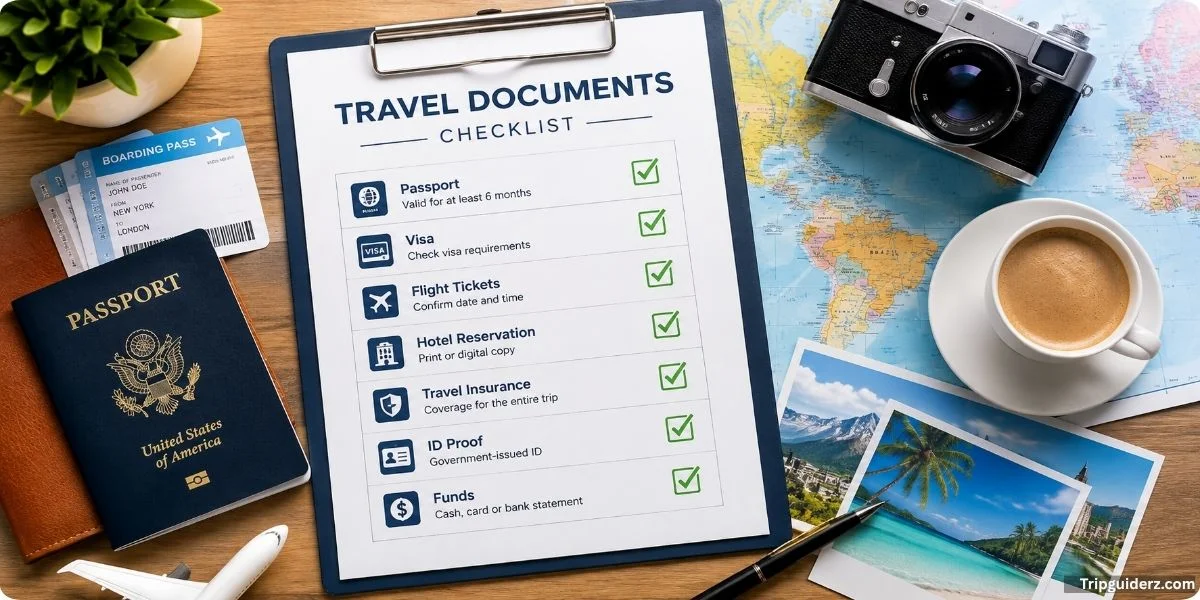
- Flight booking confirmed
- Accommodation arranged for arrival
- Local SIM card or eSIM plan researched
- Currency and initial cash on hand
- University enrollment confirmation
- Health insurance active from arrival date
- Emergency contacts saved
- All original documents packed (not just copies)
Latest Germany Student Visa Updates (2026)
The blocked account requirement has held steady at €11,904 per year (€992 per month) since the Winter Semester 2024 intake, continuing unchanged through 2026. Student work rights now allow up to 140 full days or 280 half days of employment per year. Germany’s national visa fee structure remains €75 for adults and €37.50 for minors, with limited fee exemptions for qualifying scholarship recipients and specific bilateral partnership programs. Processing times continue to vary significantly by consulate and applicant nationality, with peak summer intake months seeing the longest waits.
Flag for review: Immigration and financial-proof figures shift periodically. Confirm the current blocked account amount, visa fee, and work-hour limits directly with the applicant’s specific German embassy or the Federal Foreign Office website before final publication, since embassy-level variations do occur.
Frequently Asked Questions
Do I need a student visa to study in Germany?
Yes, if you’re a non-EU/EEA citizen planning to study for more than 90 days, unless you hold a passport on Germany’s specific visa-exempt list for post-arrival applications.
How much money is required for a Germany student visa?
The 2026 minimum is €11,904 per year, or €992 per month, typically shown via a blocked account.
How long does Germany student visa processing take?
Most applications take 4–8 weeks, though this can extend to around 12 weeks in high-demand countries or during peak intake season.
Can I work while studying in Germany?
Yes, international students can work up to 140 full days or 280 half days per year without a separate work permit.
Is IELTS mandatory for Germany?
Only for English-taught programs German-taught programs require proof of German proficiency instead, typically B1 to C1 depending on the course.
What is a blocked account?
A German bank account that holds your required living-expense funds and releases them in fixed monthly installments as proof of financial self-sufficiency.
Can I bring my spouse?
Yes, spouses and minor children can apply for family reunification permits alongside a student visa, subject to additional financial and documentation requirements.
Can I stay in Germany after graduation?
Yes, graduates can apply for an 18-month job seeker residence permit, then transition to an EU Blue Card or standard work permit once employed.
Can I convert a visitor visa into a student visa?
Generally, no a Schengen tourist visa cannot be converted into a national student visa from within Germany you typically need to apply from your home country.
What happens if my visa is rejected?
You can file a formal remonstration with the consulate or reapply with corrected documentation, depending on the stated reason for refusal.
How early should I apply?
Apply as soon as you receive your admission letter, ideally at least 3 months before your intended start date.
Can I study in Germany without German language skills?
Yes, many bachelor’s and master’s programs are taught entirely in English, though basic German is helpful for daily life and part-time work.
Conclusion
The Germany student visa process rewards early preparation more than anything else. Get your admission letter, open your blocked account, and book your embassy appointment as soon as your timeline allows the biggest delays almost always come from late starts, not embassy backlogs. Consulates and Ausländerbehörden move at a fairly predictable pace once your file is complete; it’s the missing document, the unbooked appointment, or the blocked account opened at the last minute that turns a routine process into a stressful scramble. Students who treat the visa timeline as a checklist to start the moment they receive their admission offer rather than something to tackle a few weeks before their intended arrival consistently have the smoothest path to Germany. When in doubt, start earlier than you think you need to.
Please Read More Informative Articles:
Oman Visa Guide | Types, Requirements, Fees & How to Apply
Australia Tourist Visa Requirements: All You Need to Know

Arman Ashraf is a content writer focused on travel and tourism. He creates practical, well-researched travel guides, destination articles, and travel tips designed to help readers plan trips with greater confidence. His work combines clear, engaging writing with SEO best practices, covering destinations, things to do, travel planning, and useful advice for travelers. Arman is committed to producing helpful content that makes discovering and planning travel easier.