

Istanbul travel tips matter more than most first-time visitors expect, because this is not a city that forgives guesswork. Straddling two continents across the Bosphorus, Istanbul is home to roughly 15.75 million residents, according to Turkey’s Statistical Institute (TÜİK), making it Europe’s largest city and one of the most populous urban centers on earth. That scale shapes everything how you move, where you stay, how much cash to carry, and what to expect when visiting a working mosque like the Hagia Sophia. Knowing the basics of public transport, from tram lines to cross-Bosphorus ferries, and having an Istanbulkart ready before you land saves real time and avoids the kind of stress that derails a first visit.
Istanbul also rewards travelers who understand its rhythm. A single day can realistically include a morning among centuries-old monuments like the Hagia Sophia and Topkapi Palace, a midday ferry crossing to a neighborhood on the opposite continent, and an evening in a district that feels entirely different in pace and character. That range is part of the appeal, but it is also why planning matters. In 2025, Istanbul recorded 18,972,699 foreign visitors, according to Istanbul’s Provincial Directorate of Culture and Tourism, a volume of international demand that keeps landmark sites and popular neighborhoods genuinely busy, especially during peak travel months.
This guide draws on current tourism and population data to walk through what actually matters before and during a trip choosing a neighborhood suited to your itinerary, understanding transportation options like the Istanbulkart, budgeting realistically for money and tipping norms, respecting local customs at religious sites, navigating the food scene, staying safe in crowded areas, and building a realistic itinerary that doesn’t try to force too much into too little time.
1. Plan Which Side of Istanbul to Stay On
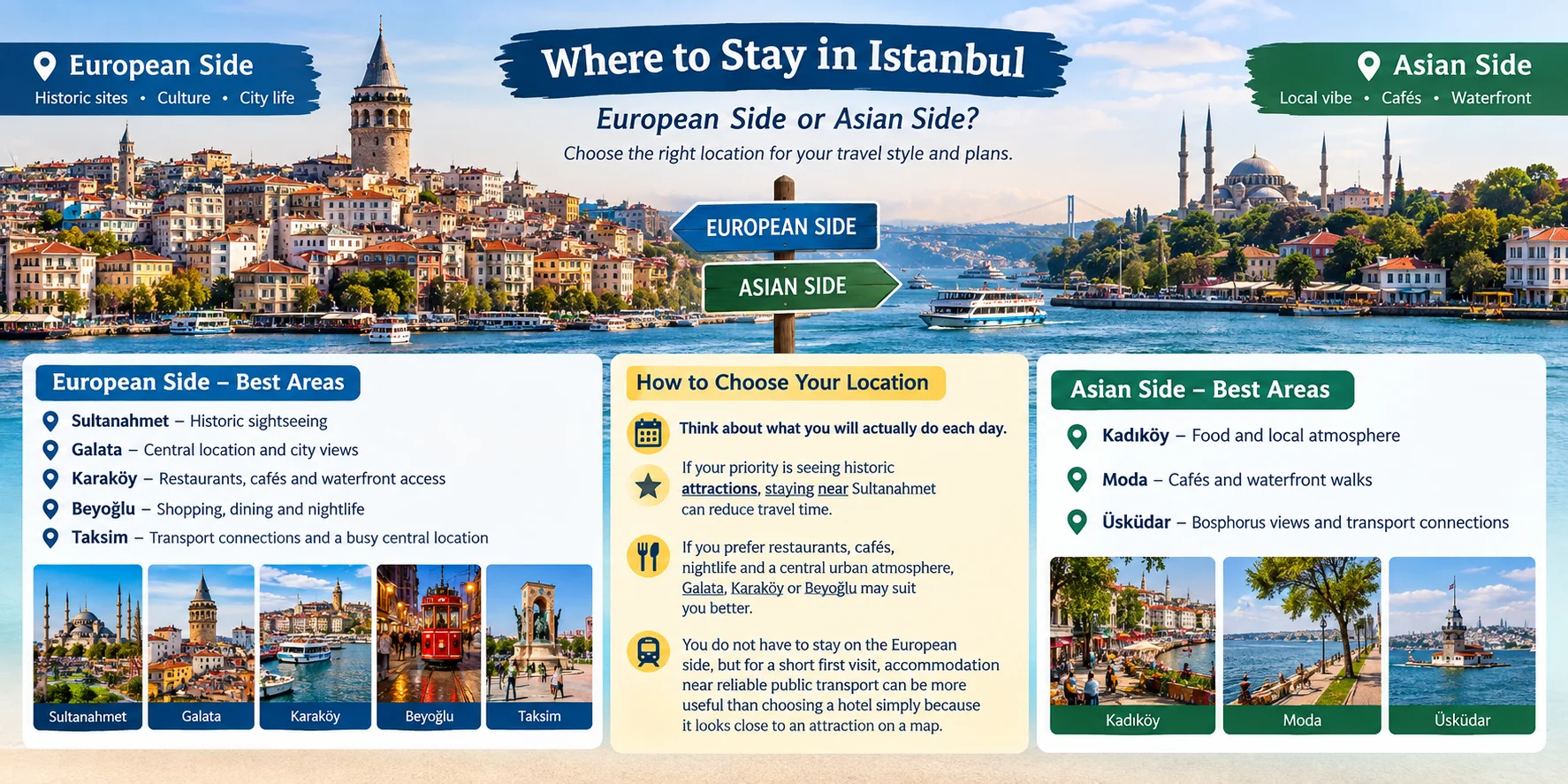
One of the first decisions to make is whether to stay on the European side or Asian side of Istanbul.
Most first-time visitors choose the European side because many of the city’s best-known historic attractions are concentrated there. Sultanahmet puts you close to major sights, while Galata, Karaköy, and Beyoğlu offer a different mix of restaurants, cafés, nightlife, and city views.
The Asian side is a different experience. Kadıköy has a lively local atmosphere, while Moda is popular for cafés, waterfront walks, and a more residential feel. Üsküdar is another useful base, particularly if you want easy access to the Bosphorus and other parts of the Asian side.
European Side
Consider areas such as:
- Sultanahmet for historic sightseeing
- Galata for central location and city views
- Karaköy for restaurants, cafés, and waterfront access
- Beyoğlu for shopping, dining, and nightlife
- Taksim for transport connections and a busy central location
Asian Side
Look at:
- Kadıköy for food and local atmosphere
- Moda for cafés and waterfront walks
- Üsküdar for Bosphorus views and transport connections
How to Choose Your Location
Think about what you will actually do each day.
If your priority is seeing historic attractions, staying near Sultanahmet can reduce travel time. If you prefer restaurants, cafés, nightlife, and a central urban atmosphere, Galata, Karaköy, or Beyoğlu may suit you better.
You do not have to stay on the European side, but for a short first visit, accommodation near reliable public transport can be more useful than choosing a hotel simply because it looks close to an attraction on a map.
2. Learn How Istanbul’s Public Transport Works
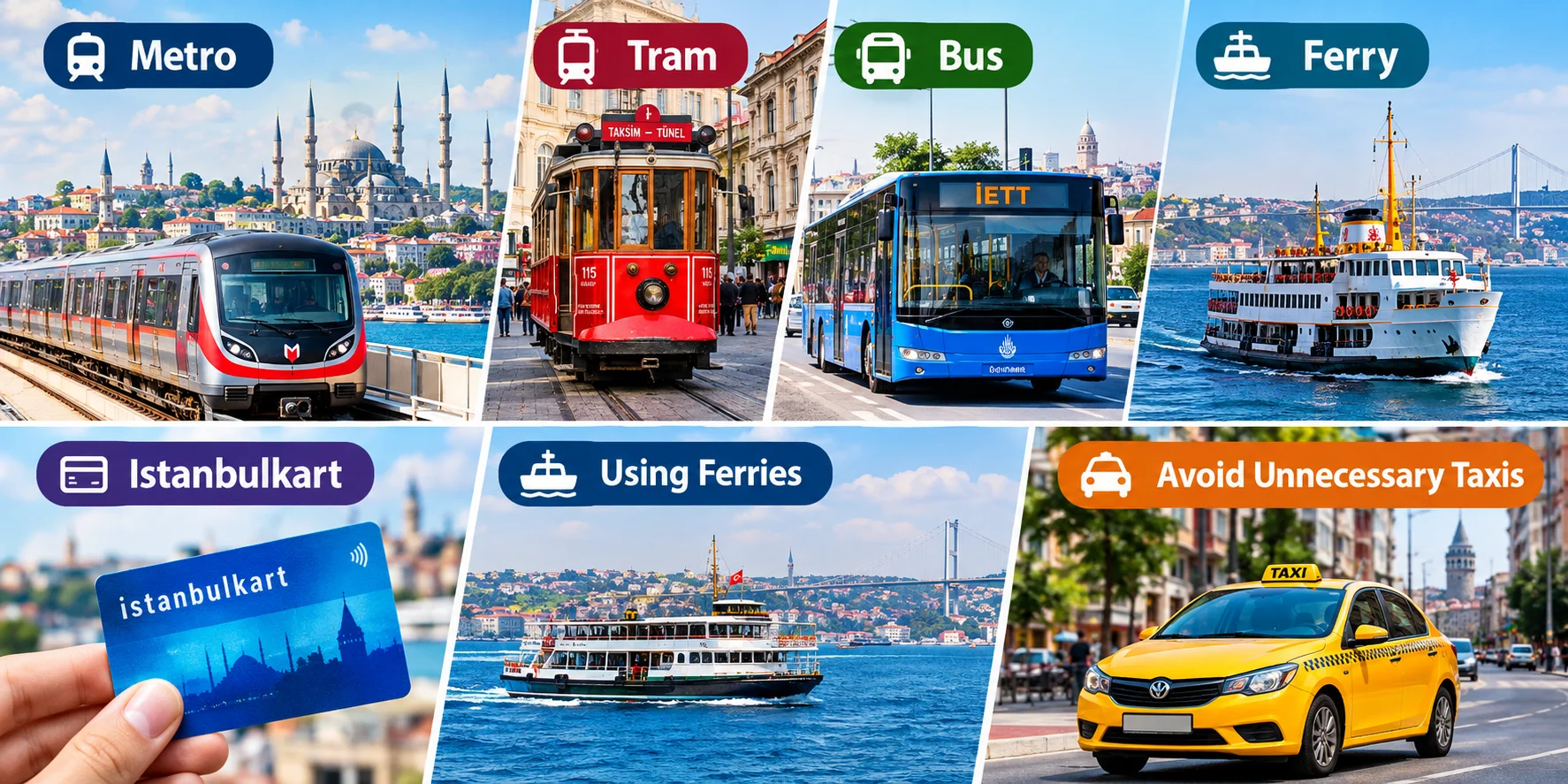
One of the most useful Istanbul travel tips is to learn the public transportation system before arriving.
Istanbul has an extensive network of metros, trams, buses, ferries, and other rail connections. Metro Istanbul provides official journey-planning tools, network maps, timetables, and fare information, while IETT provides route-planning and bus information.
For tourists, public transport is more practical than taking taxis for every journey.
Istanbmany ulkart
The Istanbulkart system is important for getting around the city. Rather than treating every trip as a separate taxi journey, visitors can use the city’s public transportation network to move between neighborhoods.
Before traveling, check the current Istanbulkart rules, fares, and available options because transportation policies and prices can change.
Metro, Tram, Bus, and Ferry
Each mode has a different advantage.
- Metro: Useful for longer journeys across the city.
- Tram: Particularly convenient around several major tourist areas.
- Bus: Helpful for destinations outside the main rail network.
- Ferry: One of the most enjoyable ways to travel between the European and Asian sides while seeing the Bosphorus.
IETT‘s official website includes journey planning, route information, airport connections, pier access, and the Otobüsüm Nerede service for checking buses.
Using Ferries as Transportation
Don’t think of a ferry only as a sightseeing activity.
A ferry can also be a practical way to move between areas such as the European and Asian sides. It can save you from making a longer road journey and gives you views of the Bosphorus at the same time.
Avoid Unnecessary Taxis
Taxis can be useful when you have heavy luggage, are traveling with children, or are heading somewhere poorly served by public transportation.
However, you don’t need a taxi for every short journey. Traffic can also make a road trip considerably slower than expected.
For taxis, check the route, confirm the fare method, and use reputable transportation options where available.
3. Know How to Get From Istanbul Airport to the City
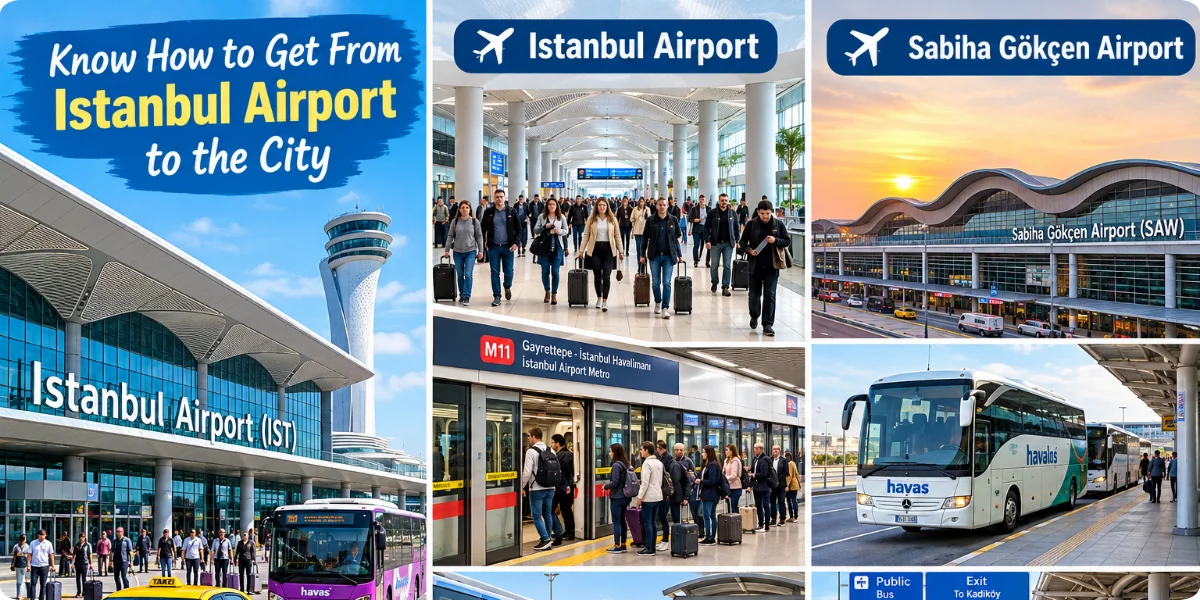
Istanbul has two major international airports used by tourists: Istanbul Airport (IST) on the European side and Sabiha Gökçen Airport (SAW) on the Asian side.
Your airport matters because the best transfer option depends heavily on where you are staying.
Istanbul Airport
Depending on your destination, options can include metro services, airport buses, taxis, and private transfers.
If your hotel is near a suitable rail connection, public transport can be practical. If you arrive late, have several bags, or are traveling with a group, a taxi or private transfer may be more convenient.
Sabiha Gökçen Airport
Sabiha Gökçen is on the Asian side, so your transfer should be planned according to your hotel location.
Public transportation, airport buses, taxis, and private transfers are available, but travel times can vary substantially depending on traffic and your final destination.
Which Airport Transfer Is Best?
| Option | Relative Cost | Convenience | Best For |
| Metro | Lower | High | Budget travelers |
| Airport bus | Moderate | High | Travelers with central accommodation |
| Taxi | Higher | High | Luggage and families |
| Private transfer | Higher | Very high | Groups and late arrivals |
Check official transportation information close to your travel date because routes, fares, and operating arrangements can change.
4. Carry Some Turkish Lira
Cards are useful throughout Istanbul, but carrying some Turkish lira is still practical.
Small purchases, markets, local businesses, tips, or unexpected situations may be easier with cash.
Cards vs. Cash
You do not need to carry your entire travel budget in cash.
A better approach is to use a card where accepted and keep a reasonable amount of local currency for smaller expenses.
ATM Tips
When withdrawing money:
- Prefer established bank ATMs.
- Check the exchange rate before accepting a conversion.
- Be cautious with unfamiliar standalone machines.
- Avoid carrying all your cash in one place.
Currency Exchange Tips
You may see currency exchange offices in airports and tourist areas, but convenience does not always mean the best exchange rate.
Compare rates and fees before exchanging a large amount.
5. Understand Istanbul’s Tourist Prices
Istanbul has options for different budgets, but prices can vary significantly between neighborhoods and businesses.
A restaurant directly beside a major tourist attraction may have a very different price structure from a small local restaurant several streets away.
Before ordering, check the menu and prices.
This is especially useful for:
- Restaurants
- Rooftop venues
- Tourist cafés
- Souvenir shops
- Taxis
- Guided tours
Watch for Tourist-Targeted Pricing
You do not need to assume that every business in a tourist area is overpriced. Instead, use simple precautions.
Look at the menu before sitting down, ask about prices when something is unclear, and check your bill before paying.
Don’t Judge All of Istanbul by Sultanahmet
Sultanahmet is one of the city’s most important sightseeing areas, but it isn’t representative of every neighborhood.
Kadıköy, Moda, Karaköy, and other areas offer different restaurant scenes, shopping experiences, and everyday rhythms.
6. Dress Appropriately for Mosques
Istanbul is home to major Islamic landmarks that also function as active places of worship.
Visitors should dress respectfully when entering mosques.
What to Wear
Modest clothing is the safest choice, particularly when visiting religious sites.
Avoid clothing that leaves shoulders or knees exposed when you plan to enter a mosque.
What Women Should Know
Women may need to cover their hair when entering certain mosques. Carrying a lightweight scarf can therefore be useful.
Requirements can vary by location, so follow the instructions provided at the entrance.
Mosque Etiquette
Remember to:
- Remove your shoes where required.
- Follow visitor signs.
- Keep noise low.
- Avoid disturbing people who are praying.
- Follow photography restrictions.
- Respect areas closed to visitors.
A little preparation makes the experience much more comfortable for both visitors and worshippers.
7. Check Mosque Visiting Times Before You Go
Don’t assume that a mosque will function like a conventional tourist attraction with identical opening hours every day.
Prayer times and religious occasions can affect visitor access.
Friday can also require additional planning because it is an important day for Muslim worship.
Before visiting a major mosque, check current visitor information and allow some flexibility in your itinerary.
This is especially important if you are trying to visit several attractions on the same day.
8. Choose the Right Time to Visit Istanbul
There isn’t one perfect season for every traveler.
Your choice depends on weather preferences, crowds, accommodation costs, and the type of experience you want.
Spring
Spring can be comfortable for walking-heavy itineraries. Parks, waterfront areas, and historic neighborhoods are particularly enjoyable when temperatures are moderate.
Summer
Summer brings long days and strong demand.
Expect more visitors around major attractions, and plan outdoor sightseeing around the weather. Starting earlier in the day can make long walking routes more comfortable.
Autumn
Autumn can provide comfortable sightseeing conditions, particularly for travelers who prefer to avoid the hottest part of summer.
Winter
Winter is generally cooler and can bring rain or occasional snow. However, it can also be a good fit for travelers who don’t mind changing weather and want to focus more heavily on museums, food, cafés, and indoor attractions.
For detailed seasonal planning, see our guide to the [best time to visit Istanbul].
9. Download Useful Apps Before Your Trip
A few apps can make Istanbul much easier to navigate.
Consider having:
- A reliable maps app
- A translation app
- A currency converter
- Public transportation information
- A ride-hailing option where available
- Your airline and accommodation apps
IETT provides official journey-planning and bus information, while Metro Istanbul provides route maps, timetables, and a journey planner.
Download Offline Maps
Offline maps can be helpful if your mobile data stops working or you enter an area with poor connectivity.
Save your hotel location and important transport stations before leaving.
10. Get a SIM Card or eSIM
Having mobile data is extremely useful in Istanbul.
You may need it for:
- Navigation
- Translation
- Checking transport routes
- Booking services
- Restaurant research
- Messaging your hotel
- Looking up opening information
Physical SIM vs. eSIM
An eSIM can be convenient if your phone supports it because you can arrange connectivity before departure.
A physical SIM can be useful if your device does not support eSIM or you prefer a local mobile plan.
Before buying anything, check whether your phone is unlocked and compatible with the network.
Where to Buy
Airport shops are convenient, but convenience can come at a higher price.
Compare available packages and check exactly how much data is included.
11. Learn a Few Basic Turkish Words
English is useful in many tourist-facing businesses, but learning a few Turkish words can make everyday interactions easier.
| Turkish | Meaning |
| Merhaba | Hello |
| Teşekkürler | Thank you |
| Lütfen | Please |
| Evet | Yes |
| Hayır | No |
| Ne kadar? | How much? |
| Hesap, lütfen | Bill, please |
| Güle güle | Goodbye |
You don’t need to become fluent before visiting. Even a handful of simple expressions can be useful when ordering food, shopping, or greeting someone.
12. Be Careful Around Tourist Areas
Like any major international city, Istanbul requires normal urban awareness.
Crowded areas can create opportunities for pickpocketing and other tourist-targeted problems.
Common Problems to Watch For
Be cautious with:
- Unclear taxi pricing
- Unsolicited offers
- Overpriced services
- Suspiciously friendly strangers offering assistance
- Pickpocketing in crowded locations
- Unclear restaurant prices
This doesn’t mean you should avoid busy areas. Places such as the Grand Bazaar and Istiklal Street are popular precisely because they are lively and central.
The practical approach is simple: stay aware, keep valuables secure, and don’t let pressure rush you into a purchase or service.
13. Know Where to Keep Your Belongings
Busy tourist locations deserve extra attention.
Keep your phone, wallet, and passport secure when moving through crowded streets and public transportation.
Particularly pay attention around:
- Grand Bazaar
- Spice Bazaar
- Istiklal Street
- Major transport stations
- Crowded trams
- Popular attractions
A crossbody bag worn securely in front can be practical in crowded areas.
You also don’t need to carry your passport around all day unless you specifically need it.
14. Don’t Try to See Everything in One Trip
One of the biggest mistakes first-time visitors make is treating Istanbul like a small city where every attraction can fit into a single day.
It can’t.
Istanbul’s size and traffic make geographic planning important.
Instead of crossing the city repeatedly, group attractions by neighborhood.
For example:
- Sultanahmet day: Historic attractions and nearby streets.
- Galata and Karaköy day: Galata area, waterfront, cafés, and surrounding neighborhoods.
- Bosphorus and Asian-side day: Ferry ride, Kadıköy, Moda, or Üsküdar.
This approach gives you more time to explore and less time sitting in traffic.
If you’re deciding how long to stay, see our guide to [how many days in Istanbul].
15. Visit Both the European and Asian Sides
You don’t have to spend your entire trip on one side of Istanbul.
The city’s location on the Bosphorus is one of its defining characteristics, so crossing between the two sides is part of the experience.
What to See on the European Side
The European side includes many of the city’s most famous visitor areas:
- Sultanahmet
- Galata
- Karaköy
- Beyoğlu
- Taksim
What to Experience on the Asian Side
Consider:
- Kadıköy
- Moda
- Üsküdar
- Asian-side waterfront areas
Take a Ferry Between Them
A ferry crossing can turn a simple transportation journey into one of the most memorable parts of your day.
Rather than automatically choosing a road route, check whether a ferry makes sense for your destination.
16. Don’t Skip Istanbul’s Local Food
Food is one of the easiest ways to experience a different side of Istanbul.
You don’t need to spend every meal at a famous restaurant.
Try a mixture of street food, casual restaurants, traditional dishes, cafés, and local bakeries.
Foods to Try
Look for:
- Simit
- Turkish breakfast
- Döner
- Kebab
- Meze
- Balık ekmek
- Baklava
- Turkish delight
- Turkish coffee
How to Choose a Restaurant
Don’t judge a restaurant only by how close it is to a major attraction.
Look at recent reviews, check the menu, compare prices, and see whether the restaurant appears to have regular local customers.
A busy neighborhood restaurant can sometimes provide a more useful introduction to everyday Istanbul than a restaurant designed entirely around sightseeing traffic.
17. Plan Your Bosphorus Experience
The Bosphorus is more than a scenic backdrop. It is part of Istanbul’s geography, transportation system, and daily life.
Public Ferry vs. Bosphorus Cruise
A public ferry can be a practical transportation option between different parts of the city.
A Bosphorus cruise is generally more focused on sightseeing and may follow a dedicated route.
Which one you choose depends on whether transportation or sightseeing is your priority.
When to Go
Morning can be useful for a quieter sightseeing experience, while later in the day can provide different light and city views.
Weather matters, too. Check conditions before booking a long boat trip.
What to Expect
Bring a layer even on a warm day because it can feel cooler on the water.
Also allow extra time if you are taking a ferry as part of a larger itinerary.
18. Respect Local Customs
Travel becomes easier when you understand the environment you’re visiting.
In Istanbul, this includes respecting religious spaces, being considerate when photographing people, and following local rules.
During Ramadan, for example, daily routines can differ from what visitors experience during other times of year. Restaurants and businesses may have different schedules, while evenings can become particularly lively.
The best approach is not to make assumptions. Check current local information and observe what people around you are doing.
19. Check the Weather Before Leaving Your Hotel
Istanbul’s weather can influence your entire day, particularly if your itinerary involves walking and ferries.
Before heading out, check:
- Temperature
- Rain forecast
- Wind
- Hourly conditions
Carry layers during changeable seasons.
A compact rain jacket or umbrella can also be useful when the forecast is uncertain.
20. Wear Comfortable Shoes
This sounds obvious, but it is one of the most practical Istanbul travel tips.
You may walk much farther than expected while exploring historic neighborhoods.
Some streets can be steep, uneven, or cobbled, and public transport often still involves walking between stations and attractions.
Comfortable walking shoes are more useful than fashionable shoes that become uncomfortable after a few hours.
21. Book Popular Attractions Strategically
Some of Istanbul’s best-known attractions can attract large numbers of visitors.
Depending on the season and current visitor arrangements, popular places can involve queues or timed access.
Potentially busy attractions include:
- Hagia Sophia
- Topkapı Palace
- Basilica Cistern
- Popular Bosphorus experiences
Check official attraction information before visiting because ticketing arrangements, entry rules, and opening schedules can change.
Don’t Overbook Your Day
If you book several attractions back-to-back, a delayed ferry or long queue can disrupt everything.
Leave some space between major activities.
That gives you time for lunch, transportation, unexpected queues, and simply exploring.
22. Keep Your Istanbul Itinerary Flexible
Istanbul rewards travelers who leave some room in their schedule.
Traffic, weather, transport changes, attraction queues, and religious schedules can all affect your plans.
Instead of creating a timetable where every hour is occupied, choose a few priorities for each day.
For example:
Morning: Major attraction
Afternoon: Nearby neighborhood and lunch
Evening: Flexible dinner or waterfront activity
That structure is much easier to manage than trying to visit six distant attractions in one day.
23. Istanbul Travel Tips for Families
Families should pay particular attention to accommodation location and transportation.
A hotel close to a useful metro, tram, or ferry connection can save significant walking and reduce the need for taxis.
Useful Family Tips
- Choose accommodation near public transport.
- Avoid packing too many attractions into one day.
- Schedule regular breaks.
- Keep snacks and water available.
- Check stroller accessibility before booking activities.
- Consider ferry rides as a family-friendly transportation experience.
For families with young children, a slightly slower itinerary is usually more practical than trying to cover every major attraction.
24. Istanbul Travel Tips for Couples
Couples can combine major sightseeing with slower experiences.
Instead of spending every day moving between monuments, leave time for:
- Bosphorus walks
- Waterfront cafés
- Rooftop views
- Neighborhood exploration
- Turkish food experiences
- Evening ferry rides
The best part of Istanbul isn’t always another attraction on your checklist. Sometimes it is sitting somewhere with a view and watching the city move around you.
25. Istanbul Travel Tips for Budget Travelers
You don’t need a luxury budget to experience Istanbul.
Save on Transportation
Use public transportation when practical instead of relying on taxis for every trip.
Eat Like a Local
Street food, bakeries, casual restaurants, and neighborhood eateries can provide good meals without requiring a high-end restaurant budget.
Choose Accommodation Near Transit
A cheaper hotel far from transportation may not actually save money if you spend more on taxis and time every day.
Use Free or Low-Cost Experiences
Walking through neighborhoods, visiting public waterfronts, exploring markets, and taking public ferries can become some of the most memorable parts of an Istanbul trip.
26. What Not to Do in Istanbul
If you’re visiting Istanbul for the first time, keep these practical mistakes in mind:
- Don’t rely only on taxis. Public transportation can be much more useful.
- Don’t ignore mosque etiquette. Check visitor rules before entering.
- Don’t exchange all your money at the airport. Compare rates and fees.
- Don’t plan every minute. Transport and queues can take longer than expected.
- Don’t stay only in tourist-heavy areas. Explore neighborhoods beyond the main attractions.
- Don’t forget comfortable shoes. Istanbul can involve a lot of walking.
- Don’t assume attraction rules never change. Check current information.
- Don’t ignore the weather. Your walking and ferry plans may depend on it.
Frequently Asked Questions About Istanbul Travel Tips
What should I know before traveling to Istanbul?
Know where you are staying, how public transportation works, which airport you are using, and what local customs apply at religious sites. It is also useful to have mobile data, some Turkish lira, comfortable shoes, and a flexible itinerary.
What is the easiest way to get around Istanbul?
For many visitors, the easiest approach is a combination of metro, tram, buses, and ferries, with taxis used when public transportation is inconvenient. Metro Istanbul and IETT provide official journey-planning and transportation information.
Should I carry cash in Istanbul?
Yes. Cards are useful, but keeping some Turkish lira available is practical for small purchases and situations where cards are not convenient.
Is Istanbul easy for first-time visitors?
It can be, especially if you stay near public transportation and group attractions by neighborhood. The city is large, so the biggest challenge for first-time visitors is usually planning travel time rather than finding things to do.
How many days are enough for Istanbul?
A short trip can cover major highlights, but spending several days allows you to explore historic Istanbul, the Bosphorus, the European side, and the Asian side without rushing. Your ideal length depends on how deeply you want to explore.
What should I avoid in Istanbul?
Avoid unnecessary taxi journeys, unclear prices, overly packed itineraries, ignoring mosque etiquette, and carrying large amounts of cash or valuables in crowded areas.
What should I wear in Istanbul?
For everyday sightseeing, comfortable clothing is fine. When visiting mosques, choose modest clothing that covers shoulders and knees and follow the specific visitor rules at the site.
Is Istanbul expensive for tourists?
Istanbul offers a wide range of accommodation, food, transportation, and activity options. Costs depend heavily on your neighborhood, travel style, and choices. Comparing prices and using public transportation can help keep expenses under control.
Do I need an Istanbulkart?
If you plan to use public transportation regularly, learning about Istanbulkart and the current fare system can make getting around easier. Check the latest official transportation information before your trip.
Can I use English in Istanbul?
English is commonly encountered in hotels, major tourist attractions, restaurants, and other tourism-related businesses. However, learning simple Turkish expressions can make everyday interactions easier.
Is Istanbul safe for tourists?
As with any large international city, travelers should use normal precautions. Keep valuables secure, pay attention in crowded areas, check prices before purchases, and use reputable transportation and accommodation providers.
Which area is best to stay in Istanbul?
There is no single best area for every traveler. Sultanahmet is convenient for historic sightseeing, while Galata, Karaköy, Beyoğlu, Kadıköy, and Üsküdar offer different combinations of food, nightlife, transport, and local atmosphere.
Istanbul Travel Tips Checklist
Before leaving for Istanbul, make sure you have considered:
- ☐ Choose your neighborhood carefully
- ☐ Check which airport you are arriving at
- ☐ Research your airport transfer
- ☐ Learn how Istanbul public transportation works
- ☐ Prepare a payment method and some Turkish lira
- ☐ Download maps and transportation apps
- ☐ Arrange mobile data or an eSIM
- ☐ Check mosque visitor rules
- ☐ Pack comfortable walking shoes
- ☐ Group attractions by neighborhood
- ☐ Check weather before long sightseeing days
- ☐ Leave space in your itinerary
- ☐ Keep valuables secure
- ☐ Check attraction information before visiting
- ☐ Allow time to experience both sides of Istanbul
Final Istanbul Travel Tips
The most useful Istanbul travel tips are not complicated. Stay near transportation, plan your days by neighborhood, keep some local currency available, dress appropriately for religious sites, use public transportation when practical, and leave enough flexibility for traffic and unexpected changes.
Most importantly, don’t treat Istanbul as a checklist of famous attractions. Give yourself time to cross the Bosphorus, eat in a neighborhood restaurant, walk through a market, sit at a café, and explore areas beyond the main tourist route.
Istanbul welcomed nearly 19 million foreign visitors in 2025, according to official Istanbul tourism statistics, so the city has extensive experience welcoming international travelers. With a little preparation, you can spend less time figuring out logistics and more time actually experiencing the city.
Read More Related Articles:
Is Istanbul Worth Visiting? A Detailed Travel Guide
Istanbul Travel Guide for First-Time Visitors

Muhammad Ali Sada is the founder of Trip Guiderz and a travel writer covering destination guides, travel planning, seasonal advice, and practical travel tips.
Email: sadaali7799@gmail.com
Phone: +923059817213
Address: Rehma street house no. 25 MA Jinnah road Multan, Punjab, Pakistan