
Buckingham Palace is one of the most recognisable landmarks in London and one of the few working royal palaces left in the world. It is the monarch’s official London residence, the setting for state banquets and investitures, and the backdrop to the balcony appearances that bring crowds onto The Mall. Few other London attractions pair this much ceremony with this much free street-level spectacle.
The palace began life as a private townhouse in 1703, became a royal home in 1761 and has been the official London residence of the sovereign since 1837. Today it has 775 rooms, 19 of which are State Rooms opened to the public each summer. Royal tradition is on show daily outside the gates, from the Changing of the Guard to the flag that signals whether the King is in London.
In this guide you will learn what the palace is, how it got here, how to reach it, what to see inside and outside, when and how to book, what it costs, and how to build a visit around the nearby sights. Prices, dates and rules are drawn from official sources and flagged where they change by season.
Quick Answer: Buckingham Palace is the British monarchy’s ceremonial headquarters and official London residence, standing at the end of The Mall in Westminster, London. Tourists visit to see the palace façade, watch the Changing of the Guard and, in summer, tour the 19 State Rooms used for royal ceremonies and state banquets.
1. What Is Buckingham Palace?
Buckingham Palace is the administrative headquarters of the monarch and, according to royal.uk, the official London residence of the UK’s sovereigns since 1837. It is a working building first and a visitor attraction second, which explains why its interiors open only for part of the year.
| Buckingham Palace at a glance | Figure |
|---|---|
| Total rooms | 775 |
| State Rooms open to visitors | 19 |
| Royal and guest bedrooms | 52 |
| Staff bedrooms | 188 |
| Offices | 92 |
| Bathrooms | 78 |
| Private garden | 39 acres |
| Guests received each year for ceremonies, state visits, investitures and garden parties | Over 50,000 |
| Original townhouse built | 1703 |
| Official royal residence since | 1837 |
i) Why Is Buckingham Palace Famous?
The palace is famous because it combines function and symbolism. It hosts state banquets, diplomatic receptions and investitures, and its East Front balcony is where the royal family greets the public on great occasions. The Changing of the Guard, the Victoria Memorial and the palace’s position at the end of The Mall complete a view that appears on postcards worldwide.
ii) Is Buckingham Palace Still a Royal Residence?
Yes, it remains the official London residence of the sovereign and the monarchy’s ceremonial centre. Official statements, however, describe it as a working palace rather than a private home. Royal officials confirmed in June 2026 that the palace will stay the primary workplace of the Royal Household and the stage for ceremonial life.
iii) Who Lives at Buckingham Palace?
No monarch lives there full time at present. Reporting on the June 2026 announcement says the King and Queen decided not to adopt the palace as a personal residence once its reservicing programme is complete, and will keep using Clarence House as their London home. The reservicing project, described in press coverage as a £369 million, ten-year programme, is replacing ageing wiring, plumbing and heating.
iv) What Makes Buckingham Palace Different From Other Royal Palaces?
Three things set it apart. First, it is still in daily official use, so its State Rooms open to the public only in a seasonal window, unlike Windsor Castle, which welcomes visitors across most of the year. Second, it is far younger than a medieval fortress-palace such as the Tower of London, because the building you see grew from an eighteenth-century townhouse. Third, its real draw is ceremony: the guard change, the balcony and the forecourt are free to see from the street.
2. History of Buckingham Palace
i) When Was Buckingham Palace Built?
The original building, Buckingham House, was built in 1703 for John Sheffield, Duke of Buckingham and Normanby. History.co.uk’s account of the palace records that the grander palace came later, once George IV hired the architect John Nash in the 1820s. The site itself had earlier been a mulberry garden planted for James I in an attempt to rear silkworms.
ii) From Buckingham House to a Royal Palace
George III bought Buckingham House in 1761 as a family home for Queen Charlotte, and it became known as the Queen’s House. Fourteen of his fifteen children were born there. His son, George IV, wanted something grander: in 1826 he persuaded Parliament to raise the renovation budget from £150,000 to £450,000, and Nash rebuilt the house into a palace. The triumphal arch Nash added at the entrance was later moved and now stands as Marble Arch.
iii) How Queen Victoria Changed Buckingham Palace
Queen Victoria was the first monarch to live in the palace, moving in in 1837. Within a decade she complained that it lacked space for her growing family and for entertaining, so architect Edward Blore added a fourth wing, completed in 1849, that closed the quadrangle. The East Front, home to the famous balcony, dates from this era, and the façade was later refaced in Portland stone in the early twentieth century. The ballroom, now the largest State Room, was also a Victorian addition.
iv) Buckingham Palace During World War II
The palace was bombed nine times during the Second World War, and the most serious attack in September 1940 destroyed the palace chapel while King George VI and Queen Elizabeth were in residence. The Royal Collection Trust archive includes Queen Elizabeth’s own letter describing the raid. The couple chose to stay in London rather than leave, and the site of the ruined chapel later became the gallery that opened in 1962. On VE Day in 1945 the royal family appeared on the balcony to greet enormous crowds.
v) Major Royal Events Hosted at the Palace
The palace is where ceremony meets everyday royal business. It hosts state banquets in the Ballroom, investitures, diplomatic receptions and summer garden parties, and more than 50,000 guests pass through each year. Balcony appearances after coronations, jubilees and royal weddings have become some of the most photographed moments in British public life. The State Rooms themselves first opened to the public in 1993.
3. Where Is Buckingham Palace Located?
i) Buckingham Palace Location in London
The palace stands in the City of Westminster, in central London, at the western end of The Mall. The postcode is SW1A 1AA. St James’s Park lies to the east and south, Green Park to the north, and the Victoria Memorial stands directly in front of the main gates.
ii) How to Get to Buckingham Palace
The simplest approach is to use public transport and walk the last few minutes, because there is no visitor parking at the palace and central London roads are busy during ceremonies. Plan your route on the Transport for London journey planner and check for line closures before you travel.
iii) Nearest Underground Stations
Four stations serve the palace. Green Park (Victoria, Jubilee and Piccadilly lines) is the closest for most visitors, around a nine-minute walk. Victoria (Victoria, District and Circle lines, plus National Rail) and St James’s Park (District and Circle lines) are both a short walk away, and Hyde Park Corner (Piccadilly line) works well if you are coming from Knightsbridge or Hyde Park.
iv) Visiting by Bus, Train, or Walking
Several bus routes pass through Victoria and Hyde Park Corner, and Victoria is also the main rail and coach hub for this part of London. Walking is often the best option: you can stroll through St James’s Park from Westminster or Trafalgar Square, or walk along The Mall to arrive just as the guard ceremony begins.
v) Best Entrance and Visitor Access Information
At the palace, the State Rooms visitor entrance is on the south side at Buckingham Gate, not at the front gates where the crowds gather. The King’s Gallery also has its entrance on Buckingham Gate. Guided East Wing tours, by contrast, enter through the front gates across the forecourt. Always follow the arrival instructions on your ticket.
4. What to See at Buckingham Palace
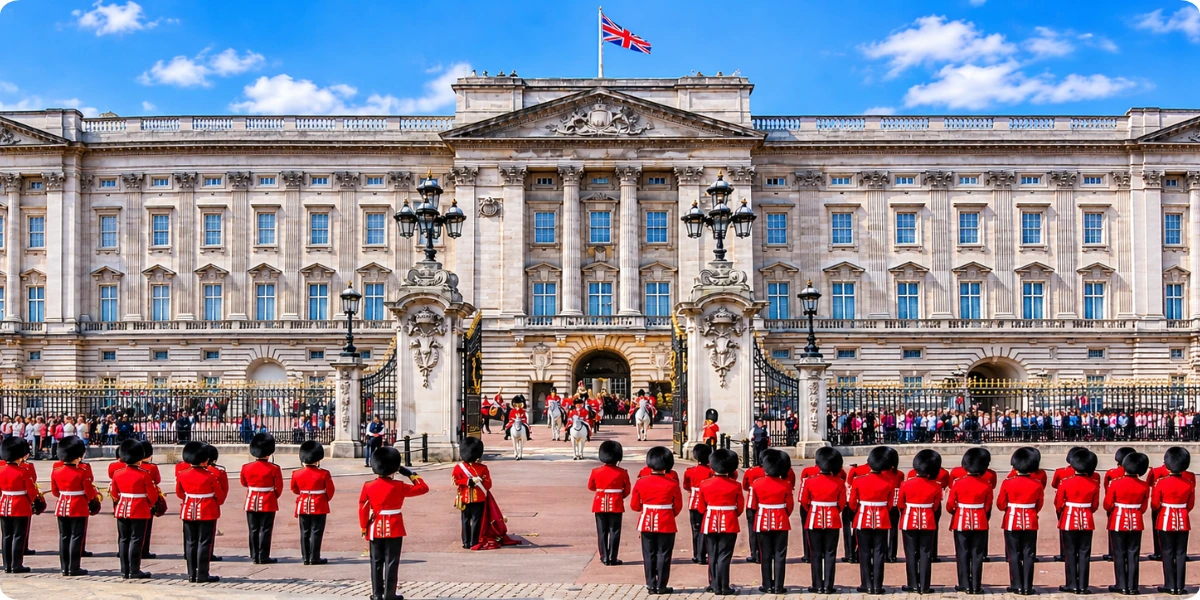
i) The State Rooms
The 19 State Rooms are used by the King and members of the Royal Family to receive and entertain guests on state, ceremonial and official occasions. The self-guided route is accompanied by a multimedia guide and finishes with a walk through the palace garden.
ii) The Throne Room
The Throne Room hosts ceremonial and official events and is one of the best-known interiors because it has been used for formal royal photographs, including wedding portraits.
iii) The Grand Staircase
The Grand Staircase, designed by John Nash, is the sweeping entrance to the State Rooms and the first moment on the route that feels truly grand.
iv) The Picture Gallery
The Picture Gallery is hung with works from the Royal Collection, including paintings by Rembrandt and Vermeer, and is an unusual chance to see old master art in a working royal setting rather than a museum.
v) The Ballroom
The Ballroom is the largest of the State Rooms and the place where State Banquets are held, making it the best room for understanding the palace’s modern diplomatic role.
vi) The Palace Balcony
The balcony on the East Front is where the royal family traditionally appears to greet crowds. It was installed in Victoria’s reign and has framed moments such as VE Day in 1945. Visitors on the standard State Rooms route cannot stand on it, but the winter East Wing tour visits the Centre Room that opens onto it.
vii) The Royal Mews
The Royal Mews is home to historic royal carriages and a working stable, and its collection includes the Gold State Coach of 1762, used at coronations. It has its own seasonal calendar and tickets, and Royal Collection Trust’s visit page currently lists the next opening as 4 March 2027. It can close during State Visits and royal events.
viii) The King’s Gallery
The King’s Gallery, built in 1962 on the site of the chapel destroyed in 1940, shows changing exhibitions from the Royal Collection. The current show, Queen Elizabeth II: Her Life in Style, was extended to April 2027, and details are listed on the Visit London page for the gallery. Entry is separate from the State Rooms.
5. Changing of the Guard at Buckingham Palace
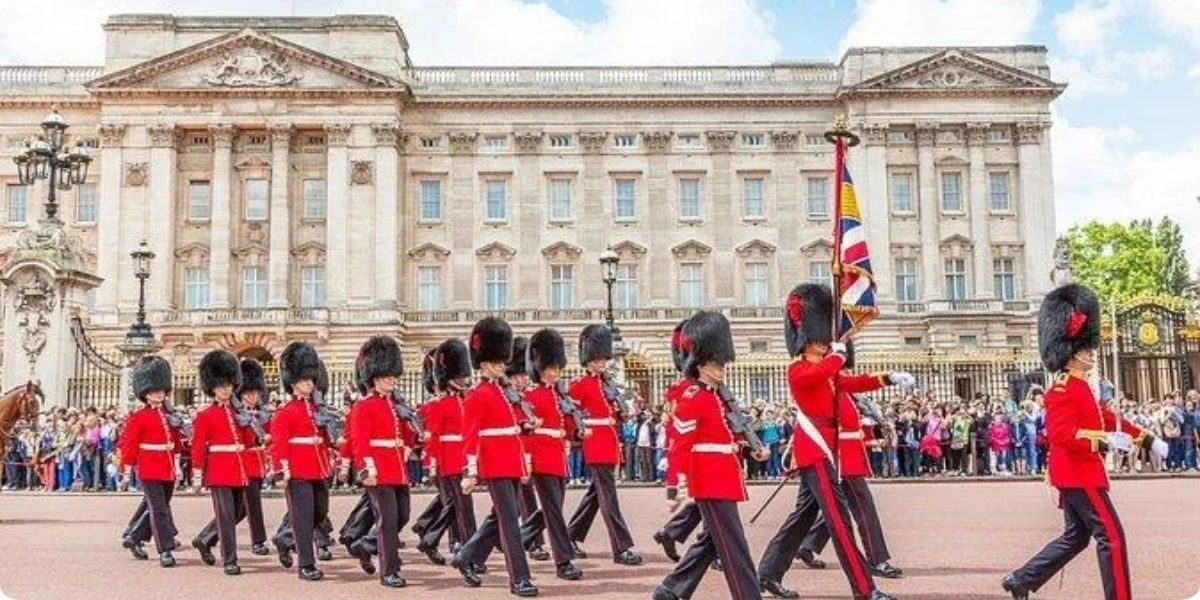
i) What Is the Changing of the Guard?
It is a formal ceremony in which the soldiers guarding the palace are relieved by a New Guard, which marches up from Wellington Barracks accompanied by a band or Corps of Drums. The Army’s ceremonial page explains that the King’s Guard has two detachments, one for Buckingham Palace and one for St James’s Palace, and traces the tradition back over 500 years.
ii) When Does the Changing of the Guard Take Place?
The Household Division’s published pattern has the King’s Guard changing at Buckingham Palace on Mondays, Wednesdays and Fridays at 11:00, with Windsor Castle taking the other days. On non-guard-change days the guard is inspected in a shorter ceremony at 15:00, and some Sundays have a morning parade. Schedules are issued in advance and can change, so check the Household Division calendar before you go.
iii) Where Is the Best Place to Watch?
The closest view is at the palace railings and around the Victoria Memorial, but it fills early. The procession can be watched along The Mall, where the St James’s Palace detachment marches towards the palace, and St James’s Park often serves as an overflow viewing area. Timings in published guides place the St James’s Palace inspection around 10:30, the palace forecourt activity from about 10:43 and the main handover at about 11:00.
iv) How Long Does the Ceremony Last?
The handover at the palace lasts roughly 45 minutes, and the wider sequence from St James’s Palace to the departure of the Old Guard runs from about 10:30 to 11:45.
v) Tips for Getting a Good Viewing Spot
- Arrive around an hour early on popular days to claim a place near the railings.
- Stand along The Mall if you prefer an easier view of the marching band.
- Check the schedule the evening before, because ceremonies can be altered or cancelled.
- Keep belongings close in dense crowds and avoid blocking the pavements.
6. Can You Go Inside Buckingham Palace?
i) Is Buckingham Palace Open to the Public?
Partly. The State Rooms open each summer for a fixed season, and outside that window the palace opens only on selected dates for guided tours. Royal Collection Trust’s Buckingham Palace page lists standard admission for 8 July to 26 September 2027, and the 2026 season ran from 9 July to 27 September.
ii) When Can Tourists Visit the State Rooms?
The State Rooms are open in summer only, typically from early July to late September, by timed ticket. Reports indicate that tickets for the next summer go on sale in the autumn, so check the official ticket page when planning. Opening days within the season can vary, so choose a date only after confirming it.
iii) What Is Included in a Buckingham Palace Tour?
A standard ticket covers the 19 State Rooms, a multimedia guide, artworks and treasures from the Royal Collection and the walk through the palace garden to the exit. Royal Collection Trust recommends allowing around two to two and a half hours.
iv) Are Guided Tours Available?
Yes. The standard visit is self-guided, but summer options include a State Rooms and Garden Highlights Tour, and a State Rooms and East Wing combination. In winter, the East Wing Exclusive Guided Tour is the main way inside: it lasts about 90 minutes, runs for small groups and does not include the State Rooms.
v) What Areas Are Not Open to Visitors?
Most of the palace. Only 19 of the 775 rooms are on the public route, and the private apartments, the working offices and the bedrooms stay closed.
7. Buckingham Palace Tickets and Tour Prices
i) How Much Do Buckingham Palace Tickets Cost?
In the 2026 summer season, a standard State Rooms ticket cost £33 for adults aged 25 and over, £21.50 for ages 18 to 24 and £16.50 for ages 5 to 17, while children under five entered free with a booked ticket. Buying on the day cost about £4 more for an adult. A State Rooms and Garden Highlights Tour combination was priced at £48 for adults, and the winter East Wing Exclusive Guided Tour was listed at around £100. Royal Collection Trust revises prices between seasons, so confirm the current figure before you budget. If you are paying from abroad, the TripGuiderz currency converter calculator helps you see the cost in your own currency.
ii) Where to Buy Official Tickets
Buy directly from Royal Collection Trust (rct.uk), the charity that runs public visits to the palace. Third-party sellers offer bundles with walking tours or audio apps, which can suit some travellers, but their terms differ. Notably, Royal Collection Trust’s scheme that turns a direct ticket into a free 12-month pass excludes tickets bought through agents or tour operators.
iii) Are Discounts Available for Children and Families?
Children aged 5 to 17 pay roughly half the adult price, under-fives are free, and young adults aged 18 to 24 pay a reduced rate. Children under 16 must be accompanied by a paying adult. Disabled visitors can book concessions directly with Royal Collection Trust, eligible UK residents on certain means-tested benefits can access £1 tickets, and the “Royal Day Out” combination of the State Rooms, Royal Mews and King’s Gallery saves 10% on separate ticket prices.
iv) Is Booking in Advance Necessary?
Yes, in practice. Entry to the State Rooms is by timed slot, and a limited allocation of on-the-day tickets can sell out within hours in peak weeks, with the final weekend of the season especially busy. Booking early also secures the cheaper advance rate. To see how the palace fits into your wider London budget, run your numbers through the trip cost calculator.
v) Are There Free Things to See Around the Palace?
Yes. You can watch the Changing of the Guard from the street, admire the façade and the Victoria Memorial, walk down The Mall, and relax in St James’s Park and Green Park, all without paying. For many first-time visitors the free exterior experience is the best-value part of the day.
8. Best Time to Visit Buckingham Palace
i) Best Month to Visit
For the State Rooms, the choice is limited to the summer window, from early July to late September. The palace stayed open daily in July and August of the 2026 season and reduced its September opening to Thursday through Monday, so September can be calmer if your dates match. If you only want the exterior and the guard ceremony, late spring and early autumn typically offer milder weather and thinner crowds than the peak of summer.
ii) Best Time of Day for Photography
The palace’s main façade faces east along The Mall, so morning light usually falls on the front as you stand at the Victoria Memorial. For a different angle, walk to the Blue Bridge in St James’s Park, where the lake frames the palace to the west. On guard-change days the area near the gates is densest between about 10:00 and noon.
iii) Summer vs Winter Visits
Summer brings the State Rooms, the garden walk, longer days and the busiest crowds. Winter is quieter and colder, and the palace is usually not open to the general public then, but the East Wing Exclusive Guided Tour, the King’s Gallery exhibition and the Changing of the Guard continue. The Royal Mews runs on a seasonal calendar and is not normally open in midwinter.
iv) When Is the Palace Less Crowded?
Crowds thin on days without a full guard change: Tuesdays, Thursdays and Saturdays usually have only a shorter inspection at 15:00. Early timed slots inside the State Rooms and late afternoons outside tend to be calmer. Pair an early visit with a relaxed evening using our guide to things to do in London at night.
9. How Long Do You Need at Buckingham Palace?
The time you need depends on what you choose to do: exploring only the exterior, attending the guard ceremony, or booking an interior tour each change the answer significantly.
i) Quick Visit: 30–45 Minutes
This is enough to see the façade, photograph the gates and the Victoria Memorial, and walk a short stretch of The Mall.
ii) Standard Visit: 1–2 Hours
Allow this long if you want to watch the Changing of the Guard, which lasts about 45 minutes at the palace, and add a stroll through St James’s Park.
iii) Complete Experience: 2–3 Hours
A State Rooms visit alone takes around two to two and a half hours by Royal Collection Trust’s estimate, and adding the guard ceremony, the Royal Mews or the King’s Gallery turns it into a half-day outing.
10. What to Know Before Visiting Buckingham Palace
i) Security and Entry Rules
Arrive 15 minutes before the entry time on your ticket, and expect an airport-style security check. Bags larger than 45cm × 20cm × 30cm are not allowed, backpacks cannot be worn, and eating and drinking are not permitted inside apart from bottled water. Royal Collection Trust’s practical information page lists the restricted items in full.
ii) Photography Restrictions
Photography and filming are not permitted inside Buckingham Palace, including on the State Rooms route, and they are also restricted on the guided garden highlights tour. Outside the palace, photography for non-commercial purposes is encouraged, and ticketing information indicates the garden at the end of the visit is also permitted.
iii) Accessibility for Visitors
The State Rooms are almost entirely wheelchair accessible, and step-free alternatives can be arranged by contacting the ticketing team in advance. The multimedia guide is available with British Sign Language and subtitles, and an audio-descriptive version is provided for blind or partially sighted visitors. The route ends with a long garden walk, so plan rest stops if mobility is limited.
iv) Facilities and Restrooms
Toilets and baby-care facilities are in the garden and at the exit from the State Rooms, so use facilities before you queue. A café and an ice-cream parlour sit at the end of the visitor route and are only reachable after the State Rooms.
v) Visiting With Children
Children under five enter free, and pushchairs must be checked in before the State Rooms because they are not allowed on the route. Baby carriers and hip seats can be borrowed free of charge. For more family ideas around the capital, see our guide to the best things to do in London with kids.
vi) What to Wear and Bring
There is no dress code, but comfortable shoes matter because the visit includes a sizeable walk. Bring a small bag, your ticket on your phone, a bottle of water and a layer for changeable London weather, and leave large items at your hotel.
11. Places to Visit Near Buckingham Palace
i) St James’s Park
St James’s Park is the oldest of London’s Royal Parks and covers about 23 hectares (57 acres), according to the Royal Parks FAQ. It is bordered by three palaces, including Buckingham Palace, and is known for its resident pelicans. For more green-space ideas, browse our list of the best outdoor activities in London.
ii) Green Park
Green Park lies just north of the palace and offers quieter, more open lawns for a break. Together with St James’s Park it forms a corridor of about 42 hectares (105 acres), as the Green Flag Award park summary notes.
iii) Westminster Abbey
Westminster Abbey has been the coronation church since 1066 and welcomes over a million visitors a year, according to the Abbey’s visitor information. It is an active place of worship, so check the opening times and the Sunday restrictions before travelling.
iv) Big Ben and the Houses of Parliament
The Palace of Westminster, home to Parliament, is the oldest of the three palaces around St James’s Park. Big Ben is the nickname for the Great Bell in the Elizabeth Tower, and Parliament’s visiting page explains how to arrange tours.
v) Trafalgar Square
At the far end of The Mall, beyond Admiralty Arch, Trafalgar Square is roughly a 15–20 minute walk from the palace. It is home to Nelson’s Column and the National Gallery, and the walk follows the processional route of The Mall.
vi) The Royal Parks and Memorials
The Victoria Memorial sits in front of the palace gates, and the memorial gardens link Green Park and St James’s Park. Wellington Barracks, where the New Guard starts its march, is also nearby. If you want to leave the main sights behind, our guide to hidden gems in London suggests quieter places to explore.
12. Is Buckingham Palace Worth Visiting?
For most first-time visitors, yes, with the right expectations.
- Historical significance: the palace links Georgian townhouse history, Victorian expansion, the Blitz and modern royal ceremony in one place.
- Royal architecture and interiors: the State Rooms show Nash’s Grand Staircase, the Throne Room, the Picture Gallery and the Ballroom.
- Changing of the Guard experience: a free, atmospheric ceremony that works for visitors who never go inside.
- Photography opportunities: excellent outside, from the Victoria Memorial and the Blue Bridge, but not permitted inside the palace.
- Who will enjoy the experience most: history lovers, art enthusiasts, first-time London visitors and anyone interested in royal traditions.
- Who might prefer seeing the exterior instead: travellers visiting outside summer, those on a tight budget, very young children and anyone who dislikes queues and security checks.
13. Buckingham Palace Visitor Tips
- Book tickets through official channels. Royal Collection Trust sells tickets directly and offers benefits such as concessions that agents cannot always provide.
- Check the palace opening calendar. The State Rooms open only in a seasonal window, and the Royal Mews and King’s Gallery have their own calendars.
- Check the Changing of the Guard schedule. Ceremonies can change at short notice, so confirm the date the evening before.
- Arrive early for popular viewing areas. About an hour before the ceremony is a sensible target on busy days.
- Wear comfortable walking shoes. Both the State Rooms route and the walk through central London are long.
- Combine the visit with nearby London attractions. Build the day around St James’s Park, Westminster Abbey and Trafalgar Square, and use our international trip budget guide and our list of unique things to do in London to round out your itinerary.
14. Frequently Asked Questions About Buckingham Palace
Where is Buckingham Palace located?
Buckingham Palace stands in the City of Westminster, central London, at the western end of The Mall, with St James’s Park to the east and Green Park to the north. Its postcode is SW1A 1AA. Green Park, Victoria, St James’s Park and Hyde Park Corner stations are the closest for visitors.
Can tourists visit Buckingham Palace?
Yes, but access is seasonal. The State Rooms open each summer with timed tickets, while the King’s Gallery hosts exhibitions and guided East Wing tours run on selected winter dates. The exterior, the Victoria Memorial and the Changing of the Guard can be enjoyed from the street free of charge all year round.
Is Buckingham Palace the King’s permanent home?
No. Royal officials confirmed in June 2026 that, once the reservicing programme ends, the King and Queen will not make Buckingham Palace a personal residence and will keep living at Clarence House. The palace remains the ceremonial centre of royal life and the Royal Household’s primary workplace.
How much does it cost to enter Buckingham Palace?
For the 2026 summer season, State Rooms tickets cost £33 for adults aged 25 and over, £21.50 for ages 18 to 24 and £16.50 for ages 5 to 17. Under-fives enter free with a booked ticket. On-the-day adult tickets cost about £4 more, and prices are revised each season.
What is Buckingham Palace famous for?
Buckingham Palace is famous as the monarch’s official London residence and working palace, the setting for state banquets, investitures and balcony appearances, and the stage for the Changing of the Guard. Its 775 rooms, 19 State Rooms and the Victoria Memorial make it one of London’s most recognisable landmarks.
Can you see the King at Buckingham Palace?
Sometimes, but never on demand. The King is most reliably seen on the balcony during major ceremonial occasions, such as Trooping the Colour. When he is in London, the Royal Standard flies from Buckingham Palace or Clarence House, but a flag does not guarantee a sighting.
Is the Changing of the Guard free?
Yes, watching from the pavement costs nothing. The King’s Guard changes at Buckingham Palace on Mondays, Wednesdays and Fridays at 11:00, though dates can be altered or cancelled, so check the Household Division calendar. Arrive early for a good spot, because crowds build quickly on popular days.
How many rooms are inside Buckingham Palace?
Buckingham Palace has 775 rooms, including 19 State Rooms, 52 royal and guest bedrooms, 188 staff bedrooms, 92 offices and 78 bathrooms. Visitors on the summer State Rooms route see only the 19 State Rooms and then walk through the palace garden to the exit.
Can you take pictures inside Buckingham Palace?
No. Photography and filming are not permitted inside Buckingham Palace, including on the State Rooms route, to protect the artworks and interiors. Photos are welcome outside, along The Mall and at the Victoria Memorial, and ticketing information says the garden at the end of the visit is allowed too.
What is the nearest Tube station to Buckingham Palace?
Green Park is the closest Tube station for most visitors, roughly a nine-minute walk from the palace. Victoria, St James’s Park and Hyde Park Corner are also within a short walk. Victoria is the best choice if you arrive by National Rail, and TfL publishes live service updates.
Is Buckingham Palace worth visiting with children?
Yes, for most families, especially for the exterior and ceremony. Changing the Guard, the Victoria Memorial and the pelicans of St James’s Park suit young children, while older children who enjoy history can appreciate the State Rooms. Under-fives enter free, pushchairs must be checked in, and baby carriers can be borrowed.
Can you visit Buckingham Palace throughout the year?
Not the State Rooms, which open in summer only: 9 July to 27 September in 2026, and 8 July to 26 September in 2027 according to Royal Collection Trust. Options outside summer include the exterior, Changing the Guard, the King’s Gallery, winter East Wing tours and the seasonal Royal Mews.
15. Final Thoughts: Planning Your Buckingham Palace Visit
Buckingham Palace is more than a postcard. It began as an eighteenth-century townhouse, became a royal home under George III, grew into a palace under George IV and Queen Victoria, survived the Blitz, and today serves as the ceremonial centre of the monarchy. That layered history is what makes the visit meaningful, whether you see it from the pavement or from inside the State Rooms.
Before you travel, check official visitor information from Royal Collection Trust and the Household Division, because opening dates, prices and ceremonies change from season to season. Combine the palace with St James’s Park, Westminster Abbey, Big Ben and Trafalgar Square to turn a short stop into a full royal day, and for more ideas on planning your trip, explore our wider London travel guides.
For first-time London visitors, our recommendation is simple: watch the Changing of the Guard, stroll through St James’s Park, and add the State Rooms if your dates fall in summer. Done in that order, it is one of the most memorable half-days in the capital.

Arman Ashraf is a content writer focused on travel and tourism. He creates practical, well-researched travel guides, destination articles, and travel tips designed to help readers plan trips with greater confidence. His work combines clear, engaging writing with SEO best practices, covering destinations, things to do, travel planning, and useful advice for travelers. Arman is committed to producing helpful content that makes discovering and planning travel easier.