
Few buildings in London hold as much of the human story as the British Museum. Founded in 1753 and set in the heart of Bloomsbury, it welcomes millions of visitors who come to stand face to face with objects that shaped how we understand the past.
The appeal is easy to explain. In one free building you can move from Egyptian tombs to Greek temples, from Assyrian palace walls to Viking-age treasure, without crossing a border or buying a ticket.
The galleries behind the columned façade are famous for ancient civilizations, but the museum is just as proud of its modern exhibitions, which attract queues of their own.
Before you plan your day, know three things: entry is free but a timed booking is advised, Fridays stay open late, and two to three hours is enough to cover the highlights. If you are building a wider itinerary, our list of the best London attractions shows where the museum fits.
What Is the British Museum?
The British Museum is a free-to-enter public museum on Great Russell Street in Bloomsbury, London, devoted to human history, art and culture. Its collection spans roughly two million years and includes the Rosetta Stone, Egyptian mummies and the Parthenon Sculptures. Only special exhibitions require a paid ticket.
What Is the British Museum Famous For?
The British Museum is famous for its vast, free-to-enter collection of world history and culture, spanning roughly two million years. Visitors know it best for the Rosetta Stone, Egyptian mummies, the Parthenon Sculptures and the Sutton Hoo treasures, all displayed in a landmark building with a glass-roofed Great Court.
1. A Brief History of the British Museum
Parliament founded the museum in 1753, building it around the collection of the physician Sir Hans Sloane. It opened to the public in 1759 and moved into today’s neoclassical building, designed by Sir Robert Smirke, in stages through the nineteenth century. The glazed Great Court arrived in 2000.
2. Why the Museum Is Important to World History
Few places let you trace Egypt, Mesopotamia, Greece and Rome side by side. That breadth makes the museum a reference point for historians. It is also a focus of debate, since several famous objects, the Parthenon Sculptures above all, are subject to long-running requests for return.
3. What Makes Its Collections Unique?
The collection runs to millions of objects, though only a small fraction is on show at any time. What sets it apart is range: coins, manuscripts, sculpture, jewellery and everyday tools from nearly every inhabited continent sit within a single walkable building.
4. How the Museum Became a Major London Attraction
Free entry, a central address and the Great Court turned a scholarly institution into a mass-visitor landmark. Headline exhibitions reinforce that pull; the 2026 Bayeux Tapestry loan has produced exceptionally long online queues for tickets.
Where Is the British Museum Located?
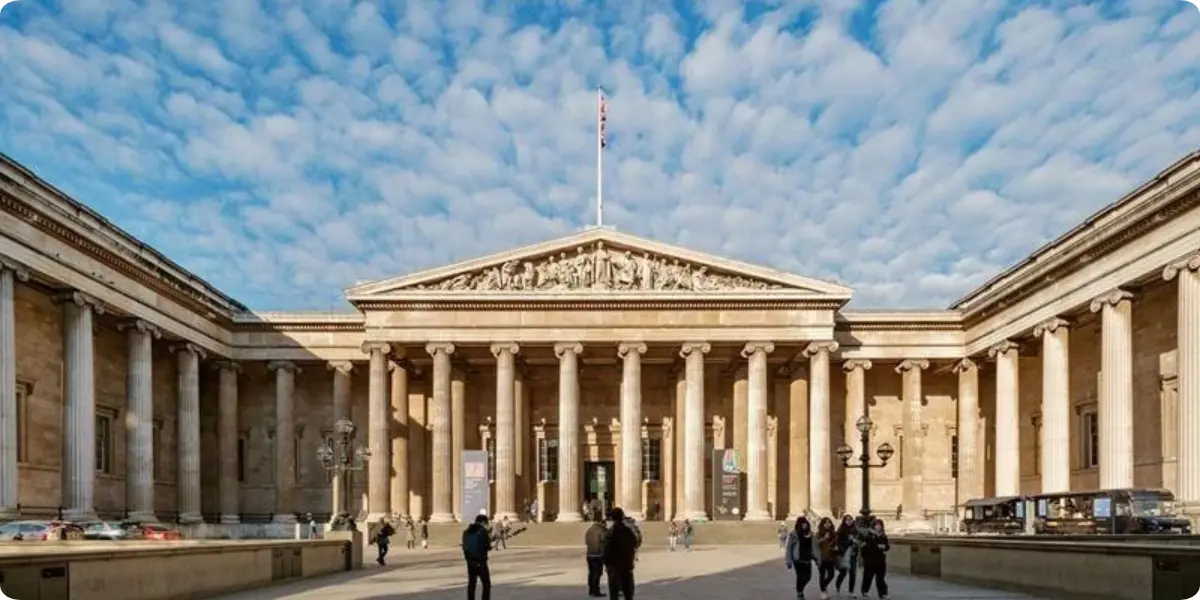
The British Museum is on Great Russell Street in Bloomsbury, central London, just north of the West End, postcode WC1B 3DG. It sits within about ten minutes’ walk of both Holborn and Tottenham Court Road stations, with a second entrance on Montague Place at the rear.
1. British Museum Address and Location
The main entrance is on Great Russell Street, London WC1B 3DG. The Montague Place entrance, on the quieter side, leads in at the rear of the building and can shorten your wait at busy times.
2. How to Get to the Museum from Central London
From King’s Cross St Pancras, take the Piccadilly line one stop to Russell Square. From Paddington, Liverpool Street or Heathrow, the Elizabeth line runs direct to Tottenham Court Road. From Waterloo, the Northern line also reaches Tottenham Court Road. Euston is about a 20-minute walk. Check live routes on the TfL Journey Planner.
3. Nearest Underground Stations
- Tottenham Court Road: Central, Northern and Elizabeth lines
- Holborn: Central and Piccadilly lines
- Russell Square: Piccadilly line
- Goodge Street: Northern line, a slightly longer walk
4. Walking Routes from Nearby Attractions
From Russell Square it is a short stroll of around five minutes. From Covent Garden allow about 15 minutes heading north-east through the West End. From Trafalgar Square the walk takes roughly half an hour via Charing Cross Road and New Oxford Street.
5. Parking Options Near the Museum
Parking is scarce and expensive, and Bloomsbury sits inside London’s Congestion Charge area. Check the current charging rules with TfL before driving, and consider a Tube or bus journey instead; the museum is far easier to reach without a car.
What to See at the British Museum
1. What Are the Must-See Exhibits at the British Museum?
Start with the Rosetta Stone, the Egyptian mummies and the Parthenon Sculptures, then add the Assyrian Lion Hunt reliefs and the Lewis Chessmen. Together they cover Egypt, Greece, Mesopotamia and medieval Europe, and fit comfortably into a focused two- to three-hour route.
2. The Rosetta Stone
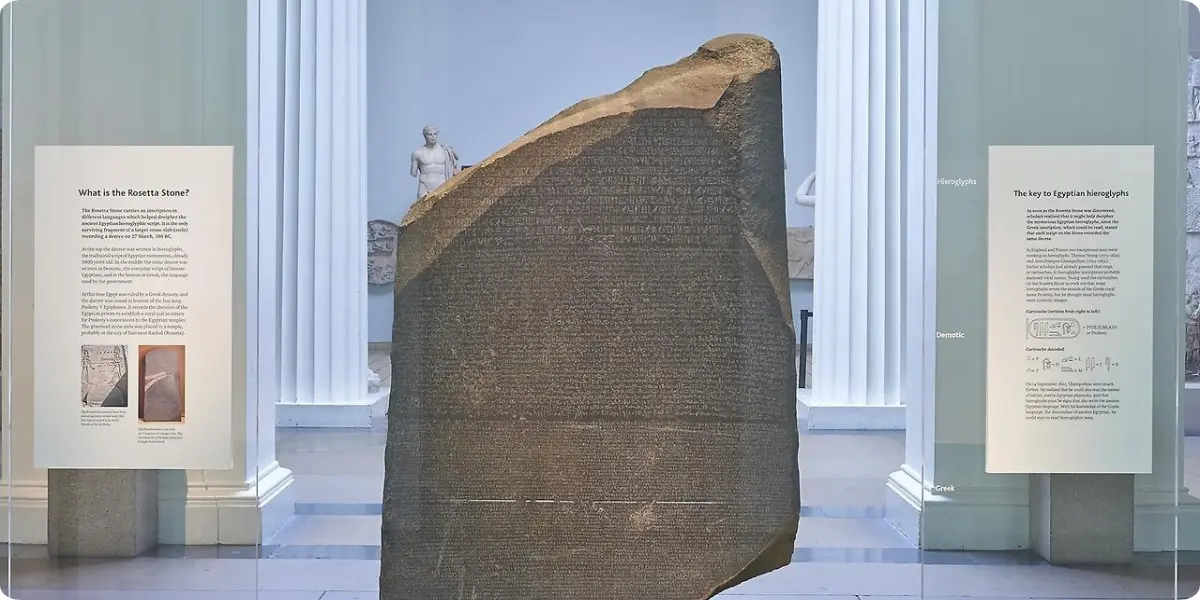
Carved with a decree from 196 BC in hieroglyphic, Demotic and Greek, this dark slab gave scholars the key to reading Egyptian hieroglyphs. French soldiers found it in 1799, and it now stands in Room 4 behind glass, usually surrounded by visitors.
3. Egyptian Mummies and Ancient Egypt Collection
The upper-floor Egyptian galleries (Rooms 62–63) hold mummies, painted coffins and animal burials. Look for the small objects as well amulets, papyri and household items that show how ordinary Egyptians lived and prepared for the afterlife.
4. Parthenon Sculptures
These marble figures and friezes once decorated the Parthenon temple in Athens. Displayed in Room 18, they are among the finest surviving examples of classical Greek art, and Greece has long asked for their return, so expect that story to be part of the interpretation.
5. Assyrian Lion Hunt Reliefs
These carved alabaster panels come from the palace of King Ashurbanipal at Nineveh, around 645 BC. The scenes of royal lion hunting are remarkably dramatic, with wounded animals rendered in close, unsentimental detail.
6. Lewis Chessmen
Carved from walrus ivory in the twelfth century, these small kings, queens, bishops and warriors were found on the Isle of Lewis in 1831. Their expressive faces, some gloomy and some wide-eyed, make them a favourite with children (Room 40).
7. Ancient Greek and Roman Collections
Beyond the Parthenon, look for painted Greek vases, Roman portrait busts, coins and engraved gems. The Portland Vase, a Roman cameo-glass masterpiece, is the single object most worth seeking out in these collections.
8. Asian and African Artifacts
The Asian galleries range from Chinese ceramics to South Asian sculpture, and the Africa gallery in Room 25 presents works including Benin pieces, whose ownership remains the subject of ongoing discussion. A permanent Korea Gallery also sits in Room 67.
British Museum Highlights You Should Not Miss
1. The Great Court
Opened in 2000, the Great Court is a glass-roofed public square wrapped around the former Reading Room. It is the museum’s orientation point: from here, every major wing is within a few minutes’ walk.
2. The Enlightenment Gallery
Room 1 occupies the old King’s Library, a long Georgian room lined with books and cabinets. It recreates the eighteenth-century idea of gathering the whole world’s knowledge in one place, and it is a quiet space after the busier galleries.
3. The Egyptian Sculpture Gallery
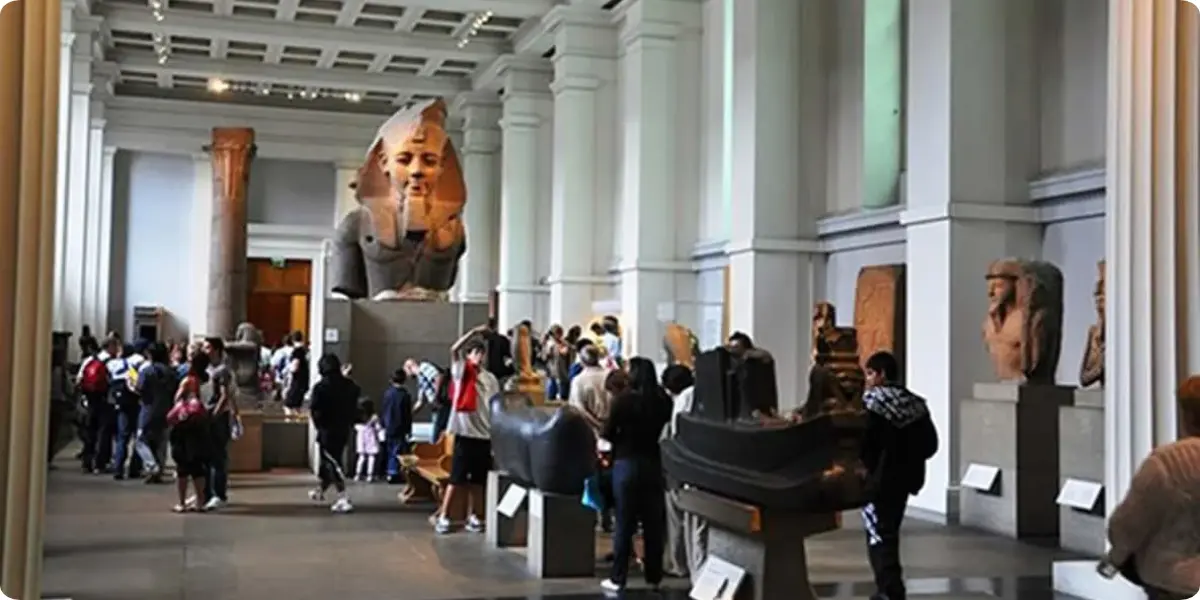
Room 4 is where scale takes over. The colossal bust of Ramesses II and the sarcophagus of Nectanebo II, Egypt’s last native pharaoh, show monumental stonework close up, a different experience from the small objects upstairs.
4. Ancient Greece and Rome Galleries
Pick out the Nereid Monument in Room 17 and the remains of the Mausoleum at Halicarnassus in Room 21. Both are large architectural fragments that put the Greek world in three dimensions.
5. The Sutton Hoo Treasures
Room 41 holds finds from the early seventh-century ship burial in Suffolk, including the iconic helmet and gold-and-garnet fittings. They overturned the idea that early medieval England was culturally poor.
6. The Museum’s Most Photographed Exhibits
The Great Court roof, the Rosetta Stone, the Parthenon friezes and Ramesses II draw the biggest crowds with cameras. For cleaner shots, visit these rooms in the first hour or during Friday’s late opening.
British Museum Tickets and Admission Prices
1. Is the British Museum Free to Visit?
Yes. General admission to the British Museum is free, including the permanent collection and the Great Court. Only special exhibitions carry a charge, with the Korea exhibition reported at roughly £18–£20, and some events and tours are paid extras. Budgeting the wider trip? Our trip cost calculator helps.
2. Can You Visit the British Museum Without Booking?
Yes, but booking a free timed ticket is advised. Visitors without tickets can enter subject to capacity, and queues for non-ticket holders are expected at busy times. A free booking secures your slot, gives priority entry during peaks and sends updates before your visit.
3. Special Exhibitions and Paid Events
The Korea exhibition runs from 1 October 2026 to 31 January 2027 in the Great Court gallery, with a closure on 1–2 December for object rotation. Tickets are sold separately from free entry; see the Korea exhibition page for current prices and slots.
4. Guided Tour and Audio Guide Costs
Themed audio tours are available through the museum’s Audio app, reportedly at about £1.99–£2.99 each, so confirm in the app. The museum also runs paid out-of-hours tours that must be booked ahead, and free object trails you can follow on your own.
5. Discounts for Students and Families
Because general entry is free, there is nothing to discount for students or families. For paid exhibitions, National Art Pass holders receive 50% off exhibitions. If money is tight, our guide to planning an international trip on a budget shows where else to save.
British Museum Opening Hours and Best Time to Visit
1. Regular Opening Hours
The museum opens daily from 10:00 to 17:00, with last entry at 16:45. It closes for three days each year, 24–26 December. Individual galleries can close at short notice, so check the day’s status before you set out.
2. Late Opening Days
On Fridays the museum stays open until 20:30, with last entry at 20:15. The evening is a pleasant, quieter way to see the galleries, and pairs naturally with dinner afterwards; our ideas for romantic things to do in London can fill the rest of the night.
3. How Long Does It Take to Explore the British Museum?
Allow two to three hours for the highlights, or four to five if you want to wander the upper floors at leisure. A full day is realistic only for history enthusiasts, because the collection is too large to see in a single visit.
4. What Is the Best Time to Visit the British Museum?
Arrive at 10:00 on a weekday morning, or come late on a Friday evening, when crowds thin. Weekends and school holidays are busiest. Winter months, especially January and February, are quieter, while July and August bring peak tourist numbers.
5. Best Time of Day to Avoid Crowds
The first hour after opening is the calmest, and the last ninety minutes before closing also thin out. Midday, roughly 12:00 to 15:00, is when tour groups converge on the Rosetta Stone and Parthenon rooms.
6. Best Months to Visit the Museum
January, February and early November are generally the quietest. Easter, summer and the run-up to Christmas are the most crowded, and headline exhibitions can sell out regardless of the season.
How to Plan Your Visit to the British Museum
1. What to Know Before Arriving
Book your free ticket, arrive only at your allocated time, and travel light. The museum asks visitors not to turn up early, since that lengthens security queues. For logistics beyond the museum, our travel planning hub is a good starting point.
2. Museum Entrance and Security Procedures
Both the Great Russell Street and Montague Place entrances have security checks. Every visitor’s bag is searched, and wheeled suitcases and larger bags are not permitted, so leave luggage at your hotel.
3. Is Photography Allowed?
Personal photography is generally permitted in the permanent galleries, without flash. Special exhibitions often have their own restrictions, so follow signs and staff guidance in each room.
4. Are There Lockers and Cloakroom Facilities?
With large bags barred, pack only essentials. Cloakroom arrangements for smaller items change from time to time, so check the museum’s Facilities page on the day of your visit rather than relying on older guides.
5. Accessibility and Wheelchair Facilities
The museum offers a wide range of services for disabled visitors. Review the Accessibility at the Museum page ahead of time to plan your route, entrance and any support you need.
6. Visiting with Children
Family visits work best with a theme: follow a free object trail, such as the Lewis Chessmen or the mummies. For older children, the museum runs a sleepover for ages 8–15, priced at £79, with an adult required.
How Much Time Do You Need at the British Museum?
1. A Quick 1-Hour Visit
See only three things: walk through the Great Court, go straight to Room 4 for the Rosetta Stone and Ramesses II, then finish at the Parthenon Sculptures in Room 18. It is rushed but gives you the museum’s signature objects.
2. A 2–3 Hour Museum Visit
Add the Assyrian galleries (Rooms 6–10) and head upstairs to the Egyptian mummies in Rooms 62–63. This is the sweet spot for first-time visitors with limited time.
3. A Half-Day Museum Experience
Extend the route to the Lewis Chessmen (Room 40) and the Sutton Hoo treasures (Room 41), then take in the Enlightenment Gallery. Add lunch in the Great Court area and you have an unhurried half day.
4. A Full-Day Visit for History Lovers
Spend the morning on ancient worlds and the afternoon on Asia, Africa and the paid exhibition. A Friday works best, since late opening gives you extra hours without a rush.
5. Suggested Route Through the Main Galleries
- Great Court for orientation
- Room 4: Rosetta Stone and Egyptian sculpture
- Assyrian galleries, Rooms 6–10
- Room 18: Parthenon Sculptures
- Rooms 62–63: Egyptian mummies (upstairs)
- Rooms 40–41: Lewis Chessmen and Sutton Hoo
- Return through the Enlightenment Gallery, Room 1
Facilities and Services at the British Museum
1. Restaurants and Cafes
The museum has cafés and a restaurant, with options clustered around the Great Court. The official Food and drink page lists current menus and opening times, which can differ on Fridays.
2. Museum Shop and Souvenirs
The shop sells books, replicas and gifts inspired by the collection. Replica Lewis Chessmen and Rosetta Stone items are among the most popular souvenirs.
3. Toilets and Family Facilities
Toilets are spread across the building, with family facilities available. The museum map shows the nearest options for each floor, which is handy when travelling with young children.
4. Wi-Fi and Visitor Information
Information points near the entrances can hand out maps and advise on gallery closures. The Audio app is the main digital companion, so download it before you arrive; mobile signal can be patchy inside.
5. Accessibility Services
The services themselves are detailed on the museum’s Accessibility page, which the team updates more often than any guidebook. Check it close to your visit date for current provision.
Places to Visit Near the British Museum
1. Russell Square
This leafy garden square is five minutes away and a good spot for a picnic or coffee break. For more green space, see our guide to the best outdoor activities in London.
2. Covent Garden
About a 15-minute walk away, Covent Garden is a West End favourite for its market, street performers and restaurants. From here you can continue towards the river and the London Eye.
3. Bloomsbury
The surrounding Bloomsbury area is a network of Georgian squares, bookshops and university buildings. It is best explored on foot; our list of hidden gems in London includes several nearby corners. If you plan to stay here, browse our hotel guides.
4. The British Library
A short ride or about a 20-minute walk north, the British Library shows historic manuscripts in its free Treasures gallery, a natural pairing for anyone who enjoys the museum’s written records.
5. Trafalgar Square
South of Covent Garden, Trafalgar Square makes a useful link between the museum and royal London. From here The Mall leads towards Buckingham Palace.
6. National Gallery
On the north side of Trafalgar Square, the National Gallery offers free entry to a major collection of European paintings, a good contrast to the museum’s objects.
Is the British Museum Worth Visiting?
Yes. The British Museum is worth visiting for its free entry, central location and unmatched range of world artefacts, from the Rosetta Stone to Sutton Hoo. Even a two-hour visit delivers several world-famous objects, which makes it one of London’s best-value attractions for first-timers and families alike.
1. What Makes It Special for First-Time Visitors?
The thrill is seeing objects you have only read about: the Rosetta Stone, a Pharaoh’s sculpture, a Greek temple frieze. A free admission policy also means you can dip in without the pressure of making every minute count.
2. Is It Suitable for Families?
It is, particularly for children who like stories and treasure hunts. Short, themed trails keep young visitors engaged, and free entry removes the cost barrier that often limits family outings in London.
3. Is It Worth Visiting If You Have Limited Time in London?
If you have only a day, pair a focused morning here with an afternoon at a contrasting landmark such as the Tower of London, so you cover both ancient world history and England’s royal past.
4. Who Should Visit the British Museum?
History fans, art lovers, families, students and curious first-time visitors will all find something here. If you dislike crowds, choose a Friday evening or an early weekday slot.
Frequently Asked Questions About the British Museum
Is the British Museum free to enter?
Yes, general admission is free. Only special exhibitions, such as Korea, are ticketed.
Can you see the British Museum in two hours?
Yes, if you stick to highlights: the Rosetta Stone, the Parthenon Sculptures and the mummies.
What is the most famous object in the British Museum?
The Rosetta Stone, a 196 BC decree in three scripts that helped unlock Egyptian hieroglyphs.
Do you need to book a ticket for the British Museum?
A free timed ticket is strongly recommended, though walk-ins are admitted subject to capacity.
Is photography allowed inside the British Museum?
Personal photography is generally allowed in permanent galleries without flash, but special exhibitions may restrict it.
Is the British Museum suitable for children?
Yes. Free object trails and family visits make it a good option for most ages.
Which Tube station is closest to the British Museum?
Tottenham Court Road, Holborn and Russell Square are all within about ten minutes’ walk.
Can you visit the British Museum and Covent Garden on the same day?
Yes. Covent Garden is about 15 minutes away on foot, so the museum in the morning and the market in the afternoon works well.

Arman Ashraf is a content writer focused on travel and tourism. He creates practical, well-researched travel guides, destination articles, and travel tips designed to help readers plan trips with greater confidence. His work combines clear, engaging writing with SEO best practices, covering destinations, things to do, travel planning, and useful advice for travelers. Arman is committed to producing helpful content that makes discovering and planning travel easier.